Can I Request a Material Cutting Test Before Buying a Bubble Wrap Machine?
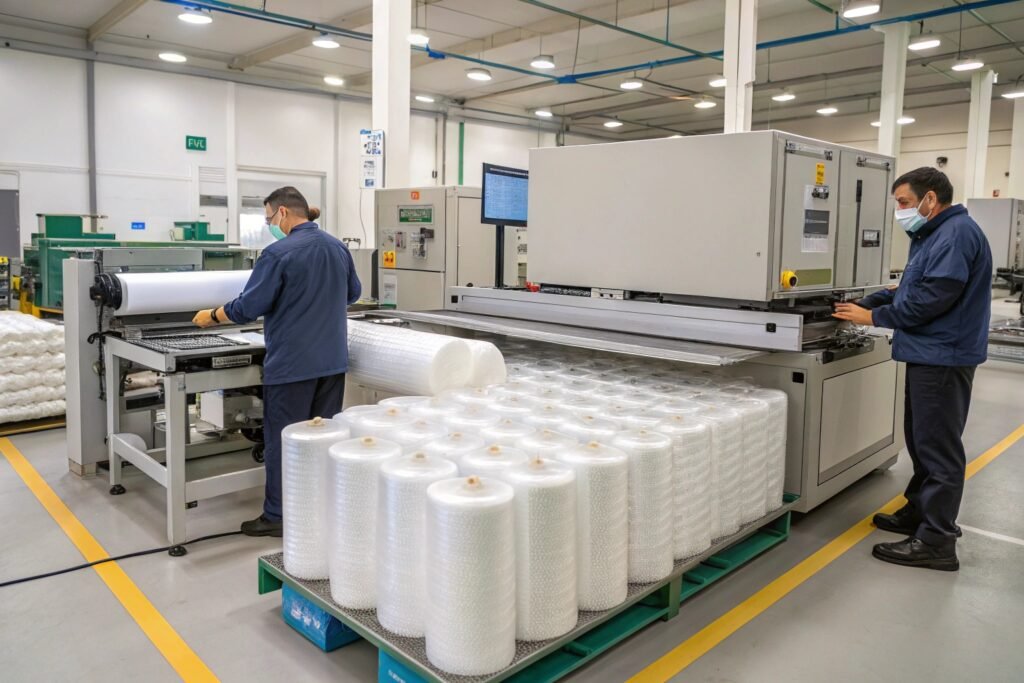
When I buy a Bubble Wrap Cutting Machine, I never want to rely only on brochures, specifications, or sales presentations. A machine may look perfect on paper, but the real question is simple:
Can it cut my actual material correctly and consistently?
That is why I always recommend requesting a material cutting test before placing an order. A cutting test allows me to verify whether the machine can handle my bubble wrap type, roll size, thickness, production speed, and quality requirements.
Yes, requesting a material cutting test before purchasing a bubble wrap machine is highly recommended. A pre-purchase test allows manufacturers to evaluate your film material, thickness, and production requirements, ensuring the machine delivers accurate cutting, reliable sealing, and consistent performance. By testing real samples, buyers can verify material compatibility, assess product quality, and reduce investment risks while receiving tailored machine configuration recommendations. This process helps ensure the selected bubble wrap machine meets operational needs and production standards before a final purchasing decision is made.
Many professional manufacturers offer sample testing before purchase. In fact, reliable suppliers often encourage customers to send materials for testing because it helps both sides avoid costly mistakes later.
For companies buying industrial equipment such as a Bubble Wrap Cutting Machine, Protective Foam Cutting Machine, Webbing Ribbon Cutting Machine, PVC Edge Banding Cutting Machine, or other converting equipment, material testing is one of the most important steps during supplier evaluation.
In this guide, I will explain:
- How to send material samples to a factory
- What test reports and videos I should request
- Whether unusual materials can be tested
- Testing fees and possible credits
- What warning signs I should watch for
Why Is a Material Cutting Test Important?
Before investing thousands of dollars in industrial machinery, I want proof that the machine works with my materials.
Bubble wrap products vary significantly1.
Some rolls are:
- Standard bubble wrap
- Anti-static bubble wrap
- Recycled bubble wrap
- Multi-layer bubble film
- Laminated bubble wrap
- Foil-faced bubble wrap
- Foam-backed bubble wrap
Even small differences in material structure can affect cutting performance2.
What I Can Verify During Testing
| Testing Item | Why It Matters |
|---|---|
| Cut Length Accuracy | Ensures finished pieces meet specifications |
| Edge Quality | Prevents rough or uneven cuts |
| Bubble Integrity | Avoids crushing bubbles during cutting |
| Feeding Stability | Prevents material wandering |
| Speed Performance | Confirms production efficiency |
| Continuous Operation | Identifies long-run issues |
A machine that performs well on one material may perform poorly on another.
That is why I always ask suppliers to test my actual material rolls instead of generic samples.
How Do I Arrange Sending Material Samples to the Factory?

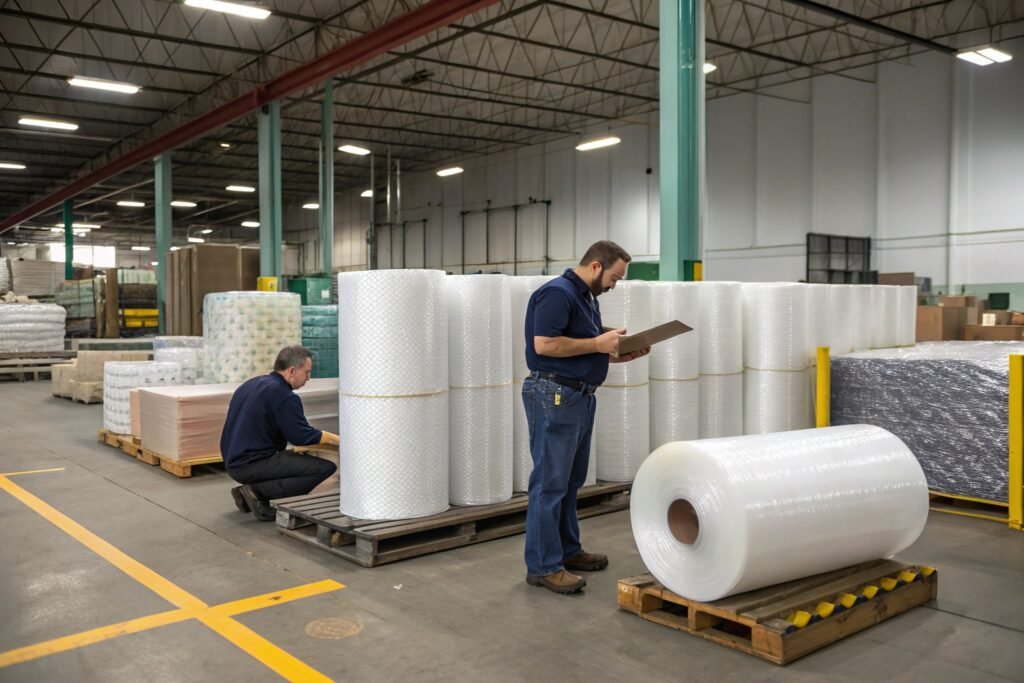
The process is usually straightforward.
Most manufacturers provide a shipping address after discussing the project requirements.
Information I Usually Provide
Before shipping samples, I send the supplier:
| Information | Example |
|---|---|
| Material Type | Bubble Wrap |
| Thickness | 4 mm |
| Roll Width | 1200 mm |
| Roll Diameter | 600 mm |
| Core Size | 3 inch |
| Desired Cut Length | 500 mm |
| Production Requirement | 24/7 Operation |
The more information I provide, the more meaningful the test becomes.
Sample Quantity Recommendations
Most suppliers prefer:
- 5–20 meters for basic testing
- 20–50 meters for detailed testing
- Full roll for long-duration trials
I always ask the supplier beforehand because different machines require different sample lengths.
Packaging Tips
When shipping samples internationally, I usually:
- Label the material clearly.
- Include material specifications.
- Mark the desired cutting lengths.
- Include contact information.
- Notify the supplier once shipment is sent.
This reduces delays and avoids misunderstandings.
Dive Deeper: Why Using Your Actual Material Is Better Than Generic Testing
Many buyers make the mistake of accepting generic demonstration videos. I understand why. Generic videos are easy to obtain and often look impressive. However, they rarely provide enough information for making a confident purchasing decision.
When I evaluate a Bubble Wrap Cutting Machine, I need to know how the machine handles my exact material. Bubble wrap products can vary greatly in bubble height, air retention, film density, layer structure, and surface treatment.
A machine may cut standard packaging bubble wrap perfectly while struggling with anti-static bubble wrap or recycled film3.
Problems That Generic Tests May Hide
| Potential Issue | Possible Result |
|---|---|
| Excessive Tension | Bubble crushing |
| Incorrect Blade Type | Poor edges |
| Feeding Problems | Inaccurate length |
| Static Build-Up | Material sticking |
| Uneven Roll Quality | Tracking issues |
I once saw a situation where a machine performed well during a supplier demonstration using their own material. After installation, the customer’s recycled bubble film behaved differently and caused feeding instability.
This is exactly why testing actual production materials matters.
Questions I Always Ask
- Can you test my exact roll?
- Can you test multiple speeds?
- Can you test different lengths?
- Can you run continuous production?
- Can you record the entire process?
A supplier that confidently answers yes to these questions usually understands industrial production requirements.
When suppliers willingly test customer materials, it often indicates that they have experience, technical confidence, and proper engineering support.
What Kind of Test Report Should I Request?
A professional supplier should provide more than a short video clip.
I usually request both visual and written documentation.
Typical Test Documentation
| Document Type | Purpose |
|---|---|
| Test Video | Shows machine performance |
| Photos | Documents cut quality |
| Measurement Report | Verifies dimensions |
| Machine Parameters | Records settings used |
| Material Information | Identifies tested sample |
Key Measurements
I ask suppliers to measure:
- Actual cut length
- Width consistency
- Edge condition
- Bubble damage rate
- Production speed
The measurements should be visible on camera whenever possible.
This helps verify that the results are genuine.
Should I Request a Live Video Test?
Absolutely.
Recorded videos are useful.
Live demonstrations are even better.
Platforms commonly used include:
- Zoom
- Microsoft Teams
- Google Meet
- WhatsApp Video
During a live test, I can ask questions in real time.
For example:
- Increase machine speed
- Reduce machine speed
- Change cut length
- Show blade condition
- Measure output pieces
This provides much greater transparency.
Dive Deeper: What Should Be Included in a High-Quality Testing Video?
Many suppliers send short videos that last only thirty seconds. While these clips may look professional, they often fail to show enough information for a serious equipment evaluation.
When I request a cutting test, I want to see the entire process from material loading to finished product collection.
Elements of a Good Testing Video
Material Identification
The video should start by showing:
- My sample material
- Roll label
- Thickness
- Width
This confirms the correct material is being tested.
Machine Setup
The operator should show:
- Feeding system
- Cutting system
- Length settings
- Control panel
This allows me to understand how the machine is configured.
Production Run
The machine should operate continuously.
I prefer seeing:
- Multiple cutting cycles
- Material feeding
- Finished output
- Operator interaction
Finished Product Inspection
The video should clearly show:
| Inspection Point | Requirement |
|---|---|
| Length | Measured visibly |
| Edge Quality | Close-up image |
| Bubble Condition | No crushing |
| Stack Quality | Neat arrangement |
Extended Operation
One of the most valuable tests is a continuous run.
I typically request:
- 30-minute test
- 60-minute test for larger projects
Some problems only appear after extended operation.
Motors may heat up.
Material may drift.
Accuracy may change.
A longer test provides a much more realistic picture of production performance.
The best suppliers understand this and willingly perform extended demonstrations.
Can the Factory Test Unusual Materials?
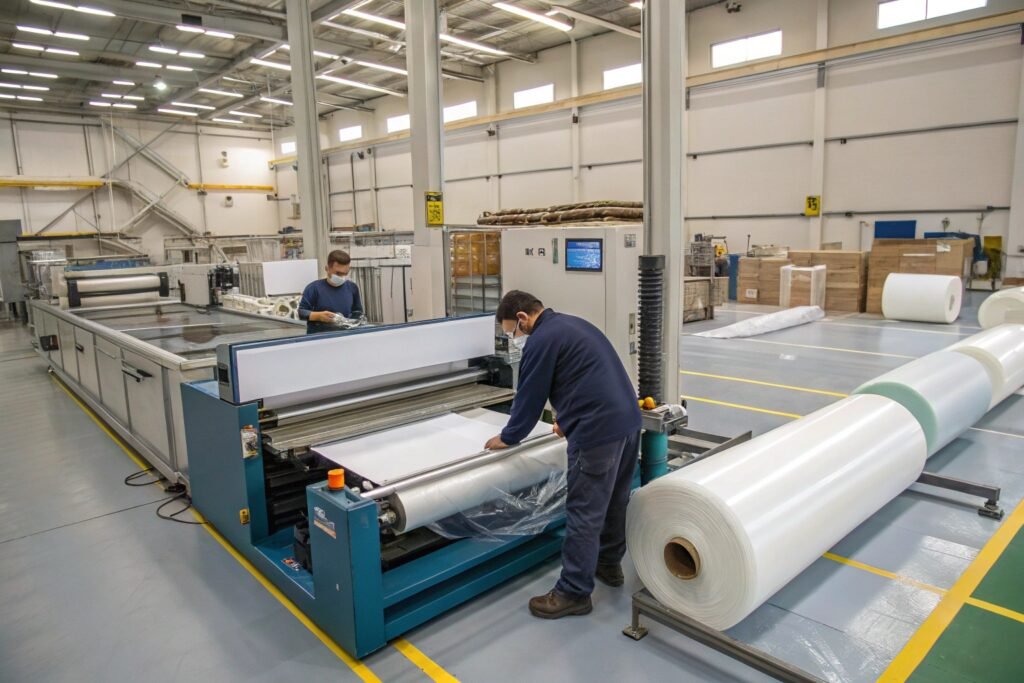
In many cases, yes.
Experienced manufacturers frequently test special materials.
Examples include:
- Foam sheets
- Protective foam rolls
- Foil-faced bubble wrap
- Multi-layer bubble film
- Insulation materials
- Laminated packaging materials
- Reflective bubble wrap
However, unusual materials often require adjustments.
Possible Machine Modifications
| Material Type | Possible Adjustment |
|---|---|
| Foam | Different blade |
| Foil Bubble Wrap | Higher cutting force |
| Thick Laminates | Stronger feeding system |
| Static Materials | Anti-static treatment |
| Reflective Film | Specialized cutting setup |
This is another reason why material testing is so valuable.
The factory can identify required modifications before production begins.
What If My Material Is Completely New?
Some manufacturers specialize in custom solutions.
If the material has never been tested before, engineers may perform several rounds of experimentation.
The process often includes:
- Material analysis
- Trial cutting
- Blade selection
- Speed optimization
- Production verification
For highly specialized applications, custom machine configurations may be necessary.
Dive Deeper: What Are the Red Flags During Material Testing?
Material testing is not only about finding a machine that works. It is also about identifying suppliers that may become problems later.
I pay close attention to how a supplier responds when I request testing.
Their behavior often reveals more than the actual machine performance.
Red Flag #1: Refusal to Test
A supplier who refuses testing may:
- Lack equipment
- Lack confidence
- Lack technical support
This immediately raises concerns.
Red Flag #2: Generic Demonstration Only
Some suppliers repeatedly send stock videos.
These videos may have been recorded months ago using completely different materials.
If they avoid testing my actual samples, I become cautious.
Red Flag #3: Missing Measurements
A test video without measurements provides limited value.
I want proof.
Not assumptions.
Red Flag #4: Extremely Short Videos
A thirty-second video cannot verify:
- Stability
- Consistency
- Long-term accuracy
Industrial equipment must perform for hours, not seconds4.
Red Flag #5: Avoiding Live Demonstrations
If a supplier continually rejects live video testing, I investigate further.
Professional manufacturers are usually willing to show their equipment operating in real time.
Red Flag #6: No Engineering Discussion
Good suppliers discuss:
- Blade selection
- Material properties
- Production goals
Weak suppliers focus only on selling.
By carefully observing the testing process, I often learn as much about the supplier as I do about the machine itself.
Is There a Fee for Material Testing?
The answer depends on the supplier.
Many manufacturers provide standard testing free of charge.
Especially when:
- The machine is a standard model
- Material testing is simple
- The project has strong purchase potential
Common Testing Fee Structures
| Testing Type | Typical Situation |
|---|---|
| Free | Standard testing |
| Small Fee | Extensive testing |
| Engineering Fee | Custom development |
| Credited Fee | Deducted from future order |
For custom machinery projects, suppliers may charge testing fees because engineers spend significant time optimizing the machine.
Can Testing Fees Be Credited Toward the Order?
In many cases, yes.
This is common for:
- Custom machines
- Large projects
- OEM equipment
- Specialized applications
I always ask:
"If I place an order, can the testing fee be deducted from the machine price?"
Many suppliers agree.
This creates a win-win situation for both parties.
Should I Use Third-Party Inspection Services?
For expensive machinery purchases, third-party inspection can provide additional confidence5.
This is particularly valuable when:
- The supplier is overseas
- The machine is customized
- The investment is substantial
Third-party inspectors can verify:
- Test procedures
- Measurements
- Machine condition
- Factory capability
Some buyers even send their own representatives to witness testing directly.
Conclusion
Yes, I can and should request a material cutting test before buying a Bubble Wrap Cutting Machine.
A professional testing process helps me verify:
- Cutting accuracy
- Edge quality
- Bubble protection
- Feeding stability
- Production consistency
I always recommend sending actual production materials rather than relying on generic demonstrations. The best suppliers provide detailed videos, measurement reports, live demonstrations, and technical support throughout the testing process.
If a supplier refuses to test my material or only provides generic videos, I treat it as a warning sign. Industrial machinery is a significant investment, and thorough testing is one of the safest ways to reduce risk before purchasing.
10 Insights About Material Cutting Tests Before Buying a Bubble Wrap Machine
-
Yes, I can and should request a material cutting test before buying a bubble wrap machine because testing shows whether the machine is suitable for my specific bubble wrap type, thickness, and bubble size.
-
Reliable suppliers offer in-house testing and viewing before purchase, and many require testing if they are unfamiliar with my packaging material.
-
During a cutting test, I can verify cut length accuracy, edge quality, bubble integrity, tension stability, and whether the machine handles my material without crushing bubbles or tearing the film.
-
I should ask the supplier to run my actual bubble wrap rolls on the machine because generic materials may behave differently from anti-static, recycled, or multi-layer films.
-
A professional supplier will provide test videos or live video demonstrations so I can evaluate machine performance without visiting the factory.
-
The test should include measuring actual sheet length and comparing it with the programmed length to verify cutting accuracy and tolerance.
-
I should request multiple cut lengths, different speeds, and continuous operation for at least 30–60 minutes to evaluate consistency and long-term stability.
-
If a supplier refuses to test my material or only provides generic demo videos, I should consider it a warning sign because reputable manufacturers understand the importance of testing.
-
For expensive or customized equipment, I may arrange a third-party inspection or send a representative to witness testing at the factory.
-
I should keep all test records, including photos, videos, measurements, and reports, because these documents help compare suppliers and serve as future reference.
HAOXINHE Insights
HAOXINHE specializes in material converting and cutting solutions for a wide range of industries, including packaging, printing, labeling, foam processing, plastic materials, webbing products, tubular materials, and industrial manufacturing.
Key equipment includes:
- Webbing Tape Cutting Machine
- Hot and Cold Cutting Machine
- High-Speed Trademark Cutting Machine
- Automatic Punching Cutting Machine
- Round Shape Cutting Machine
- Rotary Bevel Cutting Machine
- Different Shapes Cutting Machine
- Computer Tube Cutting Machine
- Wire Cutting and Stripping Machine
- Metal Pipe Cutting and Beveling Machine
- Webbing Ribbon Cutting Machine
- Bubble Wrap Cutting Machine
- PVC Edge Banding Cutting Machine
- Protective Foam Cutting Machine
HAOXINHE supports customer sample testing before production, helping buyers verify machine suitability, cutting quality, and operational performance before investment. This testing approach reduces purchasing risk and helps customers select the most appropriate machine configuration for their specific material requirements.
-
"Bubble wrap – Wikipedia", https://en.wikipedia.org/wiki/Bubble_wrap. Polyethylene bubble wrap exhibits variation in film thickness, bubble height, air retention properties, and layer composition depending on manufacturing processes and intended applications, though specific performance differences depend on individual product specifications. Evidence role: general_support; source type: research. Supports: that bubble wrap products exhibit variation in material composition, bubble structure, and film properties. Scope note: Source describes general material variations rather than quantifying the degree of variation across all bubble wrap types ↩
-
"Effects of Using Laser Technology for Cutting Polymer Films – PMC", https://pmc.ncbi.nlm.nih.gov/articles/PMC11313246/. Research on polymer film processing demonstrates that variations in film thickness, density, and layer composition affect cutting force requirements, edge quality, and dimensional accuracy during mechanical cutting operations. Evidence role: mechanism; source type: paper. Supports: that material structural properties influence cutting process outcomes. Scope note: General polymer cutting research may not address bubble wrap’s specific air-filled structure ↩
-
"Structural Defects and Processing Limitations for Polymer Film …", https://pmc.ncbi.nlm.nih.gov/articles/PMC12737061/. Anti-static bubble wrap incorporates conductive additives that alter film properties, while recycled polyethylene films may exhibit variations in density and consistency compared to virgin materials, potentially affecting processing behavior. Evidence role: general_support; source type: research. Supports: that anti-static and recycled polyethylene films have different material properties than standard films. Scope note: Does not directly prove these differences cause cutting performance issues ↩
-
"1910.178 – Powered industrial trucks. | Occupational Safety … – OSHA", http://www.osha.gov/laws-regs/regulations/standardnumber/1910/1910.178. Industrial manufacturing equipment is typically specified for continuous or high-duty-cycle operation, with designs addressing thermal management, wear resistance, and sustained accuracy requirements over production shifts lasting multiple hours. Evidence role: general_support; source type: education. Supports: that industrial production equipment is designed for continuous or extended operational periods. Scope note: Describes general industrial equipment characteristics rather than specific bubble wrap cutting machine requirements ↩
-
"Pre-shipment inspection – Wikipedia", https://en.wikipedia.org/wiki/Pre-shipment_inspection. Third-party inspection services provide independent verification of equipment specifications, quality, and performance claims, offering buyers objective assessment that reduces information asymmetry in supplier-buyer relationships, particularly for international transactions. Evidence role: expert_consensus; source type: institution. Supports: that third-party inspection provides independent verification for equipment purchases. ↩