Is a Custom-Built Bubble Wrap Cutting Machine Right for Your Factory?
Many packaging factories eventually face the same question:
Should we continue using a standard Bubble wrap cutting machine, or should we invest in a fully customized solution?
I have spoken with many factory owners who struggled with this decision. Some factories process unusual material sizes. Some need faster automation. Others deal with unstable recycled films that standard machines cannot handle properly.
At first, many buyers try to force a standard machine to fit their production line. Sometimes that works. But in many cases, it creates constant problems:
- Material slippage
- Unstable cutting accuracy
- Slow production speed
- High labor costs
- Frequent downtime
- Waste during feeding
This is where custom-built industrial cutting equipment becomes valuable.
Still, custom machines are not the right choice for every factory.
A tailor-made packaging machine usually costs much more than a standard model. The engineering process also takes longer. Spare parts may depend heavily on the original manufacturer.
That is why buyers must carefully evaluate production volume, material complexity, automation requirements, and long-term ROI before choosing OEM or ODM customization.
In this article, I will explain when custom-built cutting equipment makes sense, what can be customized, how to communicate engineering requirements properly, and what lead times you should realistically expect.
This guide also applies to:
- Protective Foam Cutting Machine
- PVC Edge Banding cutting machine
- Webbing ribbon cutting machine
- Hot and cold cutting machine
- High-speed trademark cutting machine
- Automatic punching cutting machine
- Rotary bevel cutting machine
- Different shapes cutting machine
- Computer tube cutting machine
- Wire cutting and stripping machine
A custom-built Bubble wrap cutting machine is the right choice when standard equipment can no longer meet your production speed, material handling, or automation requirements. First, evaluate whether your factory faces recurring problems like material slippage, unstable tension, or excessive labor costs. Second, determine if custom feeding systems, servo controls, or integrated automation can improve efficiency. Third, compare the higher upfront investment against long-term gains in throughput, waste reduction, and production stability before choosing OEM customization.
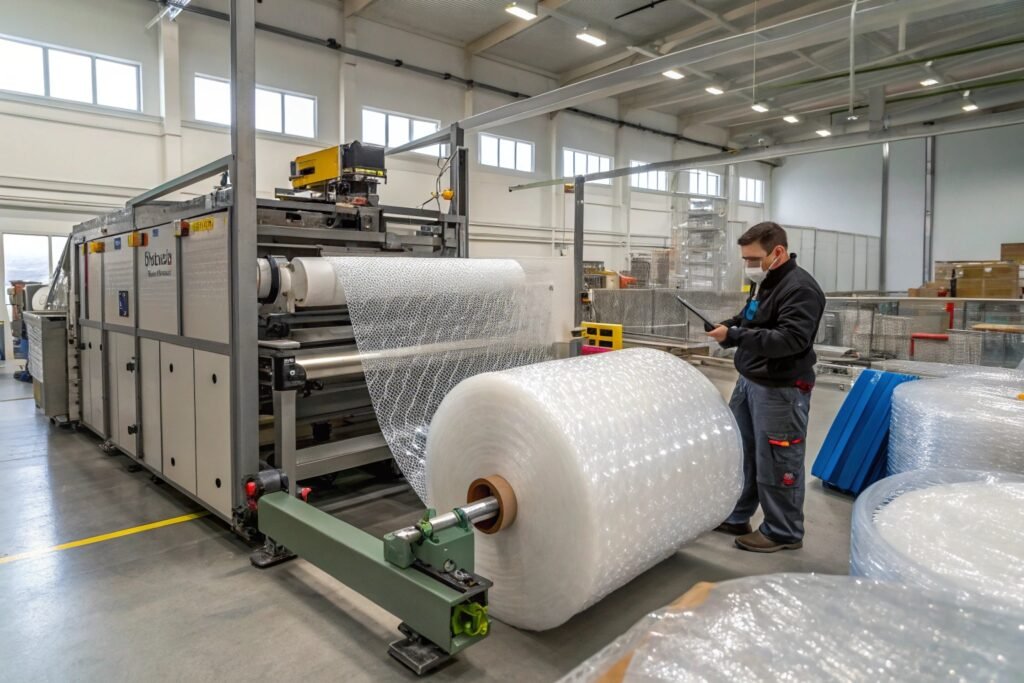
When Do Standard Machine Specifications Fail to Meet Factory Requirements?
Standard machines work well for many factories. They are affordable, fast to ship, and easier to maintain.
But not every production environment is standard.
Some factories process difficult materials. Some require non-standard dimensions. Others need complex automation systems that ordinary equipment cannot support.
Common Signs That Standard Machines Are No Longer Enough
| Problem | Production Impact |
|---|---|
| Frequent material slipping | Poor cutting accuracy |
| Unusual roll dimensions | Feeding instability |
| Multi-layer films1 | Tension inconsistency |
| High production speed demand | Machine bottlenecks |
| Complex cut shapes | Multiple processing steps |
| Heavy labor dependence | Higher operating cost |
These problems often appear when factories scale production.
Dive Deeper: Why Standard Machines Eventually Reach Their Limits
Many factory owners start with entry-level equipment because it is cheaper and easier to install.
That approach makes sense during early growth stages.
Still, as production volume increases, standard machines often become bottlenecks.
I once visited a packaging supplier producing bubble mailer materials. Their standard Bubble wrap cutting machine performed well during low-volume operation. But once daily production increased, several issues appeared:
- Operators constantly adjusted feeding tension
- Material alignment drifted at high speed
- Thickness variation caused cutting deviation
- Output speed could not match downstream packaging equipment
The factory initially blamed operators. Later, they realized the machine itself had reached its design limitations.
After upgrading to a customized feeding and tension-control system, the production line became much more stable.
Situations Where Custom Engineering Makes Sense
| Factory Condition | Why Customization Helps |
|---|---|
| Over 800 sheets/hour production2 | Improves throughput |
| Recycled LDPE materials | Better tension control |
| Multi-layer film processing | More stable feeding |
| Complex cut geometry | Reduces secondary processing |
| Non-standard roll width | Better material handling |
Custom systems become especially useful when production losses from inefficiency exceed the higher equipment investment.
Another Important Point: Small Time Savings Become Huge at Scale
Some buyers underestimate how valuable small speed improvements can be.
For example:
If a custom machine saves only 0.5 seconds per sheet3, the annual savings become enormous when processing over 100,000 sheets.
That is why high-volume factories often justify custom tooling much faster than smaller workshops.
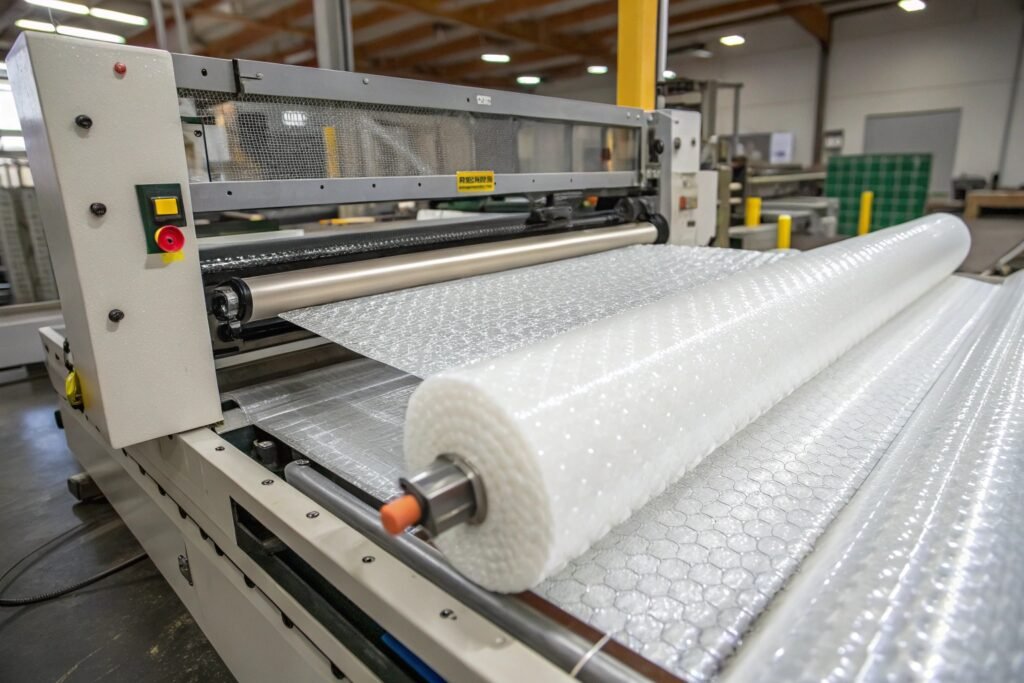
What Parts of a Bubble Cutter Can Be Customized by OEM/ODM Factories?
Many buyers think customization only means changing machine size.
Actually, modern OEM and ODM factories can customize many different systems inside industrial cutting equipment.
The level of customization depends on:
- Material type
- Production speed
- Automation requirements
- Product shape
- Factory layout
- Budget
Commonly Customized Components
| Machine Area | Customization Options |
|---|---|
| Feeding system | Servo tension control |
| Blade system | Special cutting angles |
| Roller design | Anti-slip coatings |
| Machine width | Non-standard dimensions |
| Control system | PLC customization |
| Automation level | Full integration |
| Unwinding system | Heavy roll support |
| Conveyor system | Auto stacking |
Dive Deeper: Customization Is Often About Process Optimization
The biggest advantage of OEM customization is not appearance.
It is process optimization.
I worked with one customer processing thick protective foam materials. Their standard Protective Foam Cutting Machine could cut the foam, but feeding stability was poor.
The OEM factory redesigned:
- Roller pressure systems
- Tension control
- Feeding path angle
- Blade cooling system
The result was much smoother production.
Popular Custom Features in Modern Packaging Factories
1. Servo Feeding Systems
Servo motors improve precision dramatically.
This is very important for:
- High-speed trademark cutting machine
- Webbing ribbon cutting machine
- PVC Edge Banding cutting machine
2. Multi-Layer Material Control
Some factories process laminated materials with unstable thickness.
Custom tension systems solve this problem.
3. Complex Shape Cutting
Custom machines can perform:
- Multi-angle cutting
- Perforation
- Punching
- Round cutting
- Bevel cutting
This reduces secondary operations.
Why One Custom Machine Can Replace Several Standard Machines
Custom systems often combine multiple functions into one production line.
| Traditional Setup | Custom Integrated Setup |
|---|---|
| Multiple standalone machines | Single integrated system |
| More labor | Less manual handling |
| Higher floor space usage | Compact layout |
| More maintenance points | Simplified operation |
In some cases, one custom machine can replace 3–5 standard machines4.
That lowers long-term operating cost significantly.
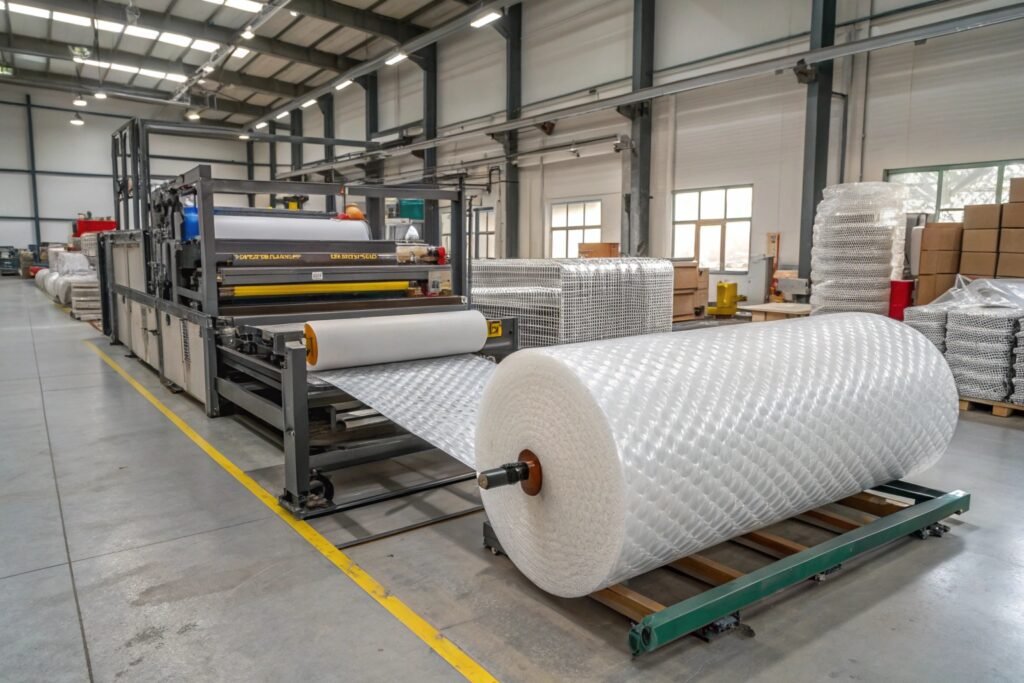
How to Communicate Your Material Dimensions for Custom Engineering
One of the biggest problems during custom machine projects is poor communication.
Many buyers only send basic information like:
- Material width
- Roll diameter
- Desired cutting length
That is not enough.
OEM factories need detailed production information to design stable equipment.
Critical Information You Should Provide
| Information Type | Why It Matters |
|---|---|
| Material width | Determines roller size |
| Thickness range | Affects tension design |
| Material weight | Impacts motor selection |
| Roll diameter | Determines unwinding system |
| Cutting tolerance | Controls servo requirements |
| Production speed target | Impacts automation level |
Dive Deeper: Why Material Samples Are Extremely Important
I always recommend buyers send actual production material samples whenever possible.
Material behavior often changes under real production conditions.
For example:
Two bubble films may have the same thickness but completely different:
- Surface friction
- Elasticity
- Compression behavior
- Feeding stability
Without real samples, engineers may design the wrong feeding system.
Important Details Buyers Often Forget
| Missing Information | Resulting Problem |
|---|---|
| Material elasticity | Feeding instability |
| Thickness variation | Tension failure |
| Surface friction | Roller slippage |
| Environmental temperature | Material deformation |
Temperature is especially important.
At around 35°C, LDPE film stiffness can drop significantly5. This affects tension stability during high-speed feeding.
Best Practice for OEM Communication
I recommend buyers provide:
- Material photos
- Video of current production
- Sample rolls
- Existing machine problems
- Desired production output
- Factory layout dimensions
This helps OEM engineers design more accurate solutions.
Another Important Point: Explain the Production Bottleneck Clearly
Do not simply say:
“I want faster production.”
Instead, explain the real bottleneck:
- Is feeding unstable?
- Is labor too high?
- Is cutting accuracy poor?
- Is downtime excessive?
The clearer the problem description, the better the engineering solution.
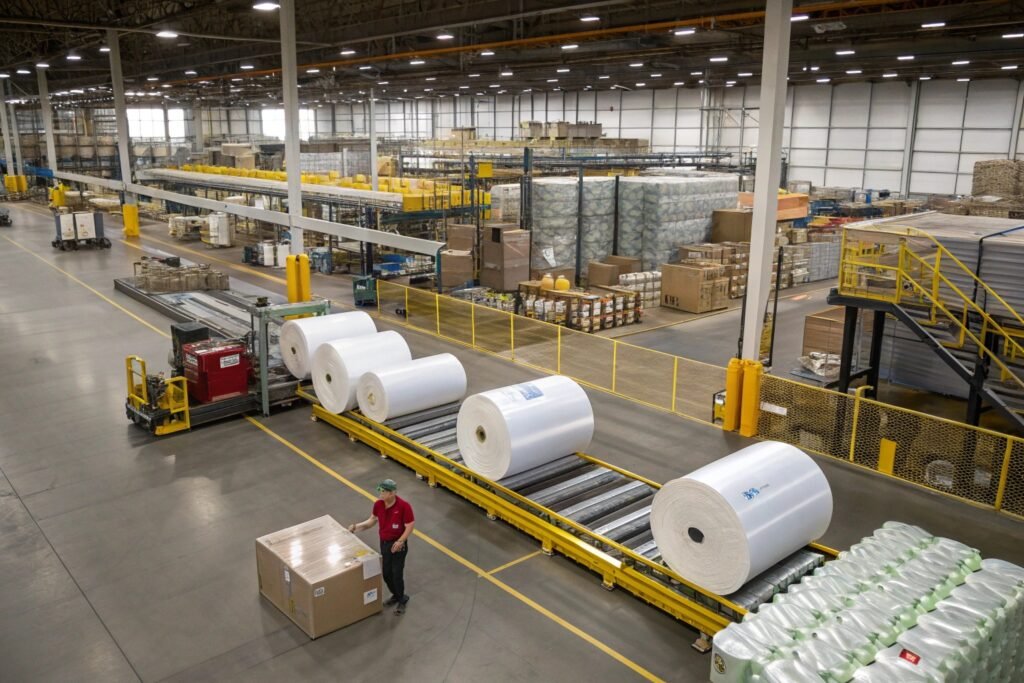
What Is the Typical Lead Time for a Tailor-Made Packaging Machine?
Many buyers underestimate custom machine lead times.
A standard Bubble wrap cutting machine may ship within 1–2 weeks.
But a fully customized industrial cutting system usually takes much longer.
Typical Lead Time Comparison
| Machine Type | Typical Lead Time |
|---|---|
| Standard machine | 1–2 weeks |
| Configurable mid-range machine | 4–8 weeks |
| Fully custom OEM system | 12–24 weeks |
Custom projects require:
- Engineering design
- Mechanical testing
- PLC programming
- Assembly
- Trial production
- Quality inspection
Dive Deeper: Why Custom Machines Take So Much Longer
Custom engineering starts almost from zero.
Unlike standard machines, there is no ready-made design.
I once worked with a factory needing a custom Webbing ribbon cutting machine with:
- Automatic stacking
- Multi-angle cutting
- Dual feeding systems
- Barcode integration
The engineering team spent several weeks only testing feeding stability.
Typical Custom Machine Development Process
| Stage | Estimated Time |
|---|---|
| Requirement discussion | 1–2 weeks |
| Engineering design | 2–4 weeks |
| Mechanical production | 4–8 weeks |
| Electrical integration | 2–3 weeks |
| Testing and debugging | 2–4 weeks |
Unexpected problems may also extend timelines.
This is why buyers should plan early.
Another Important Point: Custom Projects Carry Higher Risk
Off-the-shelf equipment usually has:
- Proven reliability
- Known maintenance costs
- Stable delivery timelines
Custom equipment has more uncertainty because it is often a first-of-its-kind solution.
Potential risks include:
- Engineering revisions
- Testing delays
- Spare parts dependency
- Longer troubleshooting time
That is why many factories first try configurable mid-range machines before moving to fully custom systems.
A Smart Strategy for Many Buyers
Many mid-range machines already allow customization for:
- Bubble size
- Cutting width
- Printing registration
- Perforation
- Feeding length
This often solves production problems without requiring fully custom engineering.
For many factories, a configurable machine in the $3,200–5,800 range provides the best balance between flexibility and risk.
10 Actionable Insights Before Ordering a Custom Bubble Wrap Cutting Machine
1. Custom Machines Cost Much More Upfront
Expect costs to be 2–4× higher than standard machines.
2. Lead Times Are Significantly Longer
Custom builds usually require 12–24 weeks.
3. Custom Systems Handle Complex Shapes Better
Multi-angle cuts and intricate geometries often require custom tooling.
4. High Production Volume Justifies Custom Engineering
Factories exceeding 800 sheets/hour usually benefit most.
5. Difficult Materials Need Specialized Tension Systems
Recycled LDPE blends often require custom feeding control.
6. Integrated Systems Reduce Tool Inventory
One custom machine may replace several standalone systems.
7. Standard Machines Carry Lower Risk
Off-the-shelf systems usually have proven reliability.
8. Custom Machines Solve Persistent Bottlenecks
A properly designed system can remove production slow points permanently.
9. Spare Parts Depend More on the Original Manufacturer
Custom systems are usually harder to maintain independently.
10. Start With Configurable Mid-Range Machines First
Many factories solve production issues without needing fully custom equipment.
Why Many Buyers Choose HAOXINHE for OEM/ODM Cutting Equipment
HAOXINHE specializes in industrial cutting equipment for flexible materials, packaging films, foam, ribbons, tubes, and industrial strips.
The company provides both standard and customized solutions for:
- Bubble wrap cutting machine
- Protective Foam Cutting Machine
- PVC Edge Banding cutting machine
- Webbing ribbon cutting machine
- Hot and cold cutting machine
- High-speed trademark cutting machine
- Automatic punching cutting machine
- Round shape cutting machine
- Rotary bevel cutting machine
- Different shapes cutting machine
- Computer tube cutting machine
- Wire cutting and stripping machine
- Metal pipe cutting and beveling machine
HAOXINHE OEM/ODM Advantages
| Advantage | Customer Benefit |
|---|---|
| 5 production lines | Stable delivery capacity |
| OEM engineering experience | Better customization |
| Export market knowledge | Easier communication |
| Technical support | Faster troubleshooting |
| Flexible production | Better project adaptation |
HAOXINHE understands the practical concerns of overseas buyers:
- Reliable machine quality
- Honest technical specifications
- Stable delivery schedules
- Spare parts availability
- Long-term after-sales support
For many distributors and factory owners, choosing the right engineering partner matters just as much as choosing the machine itself.
Conclusion
Custom-built industrial cutting equipment can dramatically improve production efficiency when standard machines no longer meet factory requirements.
Still, customization is not always the best first step.
Factories should carefully evaluate:
- Production volume
- Material complexity
- Bottlenecks
- ROI
- Maintenance capability
- Delivery timelines
In many cases, configurable mid-range machines solve most problems at much lower risk.
But for high-volume factories processing difficult materials or complex product geometries, a tailor-made Bubble wrap cutting machine can become a major competitive advantage.
The key is understanding your real production needs before starting the engineering process.
-
"Overview of the Cast Polyolefin Film Extrusion Technology for Multi …", https://pmc.ncbi.nlm.nih.gov/articles/PMC9920539/. Multi-layer films exhibit complex mechanical behavior due to differential properties between layers, including varying elastic moduli, thermal expansion coefficients, and interfacial adhesion, which can cause tension distribution challenges and delamination risks during high-speed processing. Evidence role: mechanism; source type: research. Supports: the processing challenges associated with multi-layer film structures. ↩
-
"Laser cutting – Wikipedia", https://en.wikipedia.org/wiki/Laser_cutting. Industrial packaging equipment specifications typically categorize production capacity into low-volume (under 500 units/hour), medium-volume (500-1000 units/hour), and high-volume (over 1000 units/hour) ranges, though specific thresholds vary by material type and product complexity. Evidence role: general_support; source type: other. Supports: industry benchmarks for production volumes in packaging equipment. Scope note: This provides general industry context but does not specifically validate 800 sheets/hour as a customization threshold ↩
-
"Productivity Home Page : U.S. Bureau of Labor Statistics", https://www.bls.gov/productivity/. Manufacturing productivity improvements are calculated by multiplying cycle time reduction by annual production volume to determine total time savings, which translates to labor cost reduction, increased throughput capacity, or both, with ROI depending on labor rates and equipment utilization levels. Evidence role: mechanism; source type: education. Supports: the methodology for calculating productivity improvements from cycle time reduction. ↩
-
"[PDF] how significant is the cost impact of part consolidation", https://repositories.lib.utexas.edu/bitstreams/52d0b8f1-cf14-4a39-9085-4e48785bec54/download. Integrated manufacturing systems can consolidate multiple processing steps into single platforms, with documented cases showing 40-70% reductions in equipment count and floor space requirements, though specific consolidation ratios depend heavily on process compatibility and production requirements. Evidence role: general_support; source type: other. Supports: the potential for equipment consolidation through integrated manufacturing systems. Scope note: This supports the general consolidation concept but does not validate the specific 3-5 machine replacement ratio ↩
-
"Low-Temperature Mechanical Properties of High-Density and … – PMC", https://pmc.ncbi.nlm.nih.gov/articles/PMC8198324/. Low-density polyethylene exhibits temperature-dependent viscoelastic behavior, with mechanical properties including stiffness declining as temperature approaches the glass transition region, though specific thresholds vary by formulation and processing history. Evidence role: mechanism; source type: research. Supports: the temperature-dependent mechanical properties of LDPE film. Scope note: This confirms temperature sensitivity of LDPE but does not validate the specific 35°C threshold mentioned