How to Select a Bubble Wrap Sheeting Machine with Custom Punching Holes?
Bubble wrap packaging is no longer just about simple protective cushioning.1 Many modern packaging applications now require customized perforations, easy-tear lines, hanging holes, vent holes, and special punch layouts for automated packaging systems and retail packaging solutions.
I often see packaging companies struggle when selecting the right Bubble wrap cutting machine because they focus only on cutting speed and ignore punching accuracy, tooling flexibility, and feeding stability. In reality, a custom punching system requires much more precision than a standard sheeting machine.
At HAOXINHE, I manufacture advanced industrial cutting equipment including Bubble wrap cutting machine systems, automatic punching cutting machine solutions, webbing ribbon cutting machine equipment, hot and cold cutting machine systems, Protective Foam Cutting Machine solutions, and PVC Edge Banding cutting machine equipment. Through years of industrial production experience, I understand how important proper punching technology is for high-quality packaging production.
In this guide, I will explain how to choose the correct bubble wrap sheeting machine with custom punching capabilities, and I will answer the most common technical questions buyers ask before purchasing.
A bubble wrap sheeting machine with custom punching capability improves packaging flexibility by combining precision cutting, perforation, and programmable hole positioning in one system.
- Use servo feeding and digital controls for accurate punch alignment and repeatable sheet sizes.
- Select modular perforation blades for easy-tear lines, vent holes, or retail packaging designs.
- Choose multi-function machines that switch between solid cutting and punching modes to reduce setup time and increase production efficiency.
Advanced punching systems help packaging manufacturers reduce waste, improve consistency, and support customized packaging workflows.
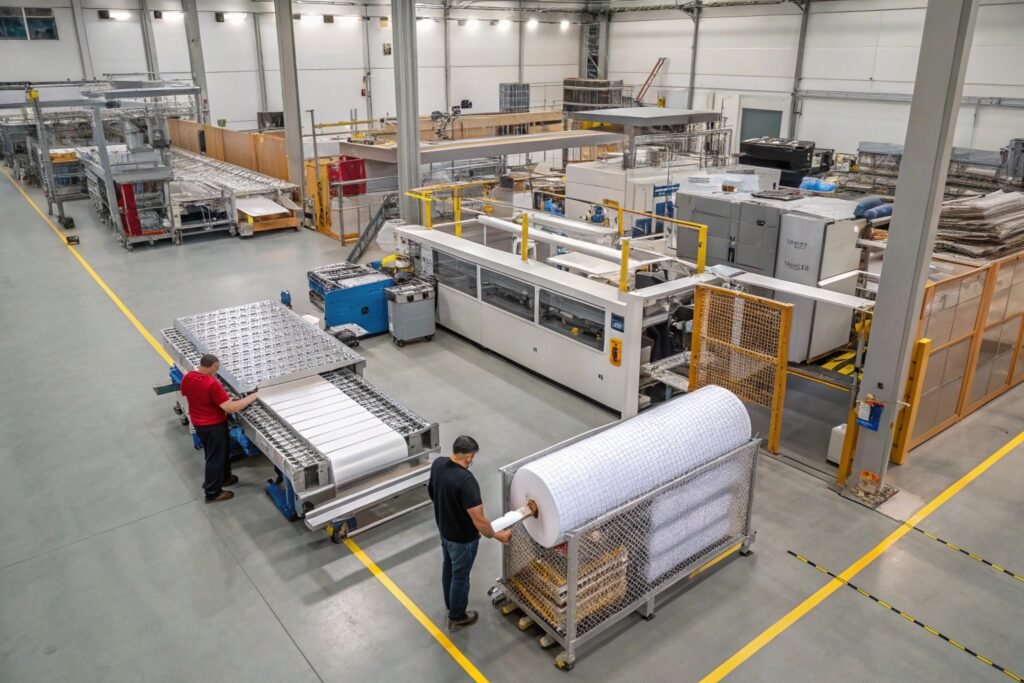
Why Custom Punching Matters in Bubble Wrap Production
Many packaging companies now require bubble wrap sheets with:
- Easy-tear perforation lines
- Hanging holes
- Ventilation holes
- Custom die-cut patterns
- Registration punching
- Retail display perforations
- Multi-section tearing zones
These features improve packaging convenience and support automated packaging workflows.
A professional Bubble wrap cutting machine with punching capability helps manufacturers produce consistent, repeatable sheet designs without relying on manual perforation tools.
What Is the Difference Between Full Cutting and Perforation Punching?
This is one of the most important questions when selecting a punching machine.
Although both methods process the material, they serve very different purposes.
Full Cutting
Full cutting completely separates the material into individual sheets or sections.
The blade cuts through the entire bubble wrap structure from top to bottom.2
Full Cutting Applications
| Application | Purpose |
|---|---|
| Finished Bubble Wrap Sheets | Final product separation |
| Packaging Inserts | Individual pieces |
| Protective Layer Sheets | Exact-size packaging |
| Foam Padding Sections | Complete material separation |
Perforation Punching
Perforation punching creates partial cuts or small punch holes while keeping the material connected.3
The material can later tear easily along the perforated line.
Perforation Applications
| Application | Purpose |
|---|---|
| Easy-Tear Packaging | User convenience |
| Roll Dispensing | Controlled tearing |
| Multi-Pack Separation | Section division |
| Retail Packaging | Easy opening |
Dive Deeper: How Full Cutting and Perforation Affect Production
Many buyers think perforation and cutting are almost the same. In reality, the tooling, pressure control, and feeding precision are completely different.
How Full Cutting Works
A full cutting Bubble wrap cutting machine uses a solid blade to separate the material entirely. The blade pressure must remain stable across the full width of the material.
If the pressure becomes uneven:
- Some sections may remain attached
- Edges may become rough
- Bubble structure may deform
This is especially important when processing thicker bubble film or laminated protective materials.
How Perforation Punching Works
Perforation systems use specialized punch tooling or segmented blades.
Instead of cutting continuously, the blade creates controlled gaps between cuts.
This produces a tearable connection line.
Typical Perforation Styles
| Perforation Type | Feature |
|---|---|
| Micro Perforation | Smooth tearing |
| Wide Gap Perforation | Stronger connection |
| Easy-Tear Line | Retail convenience |
| Vent Hole Punching | Air release |
The feeding system must maintain very accurate registration because perforation alignment affects tearing quality.
If the machine feeding drifts slightly:
- Tear lines become uneven
- Holes misalign
- Product appearance decreases
That is why modern automatic punching cutting machine systems use servo feeding control and digital positioning systems for higher accuracy.
At HAOXINHE, I often recommend machines with programmable pressure adjustment because bubble wrap materials react differently depending on film thickness and bubble height.
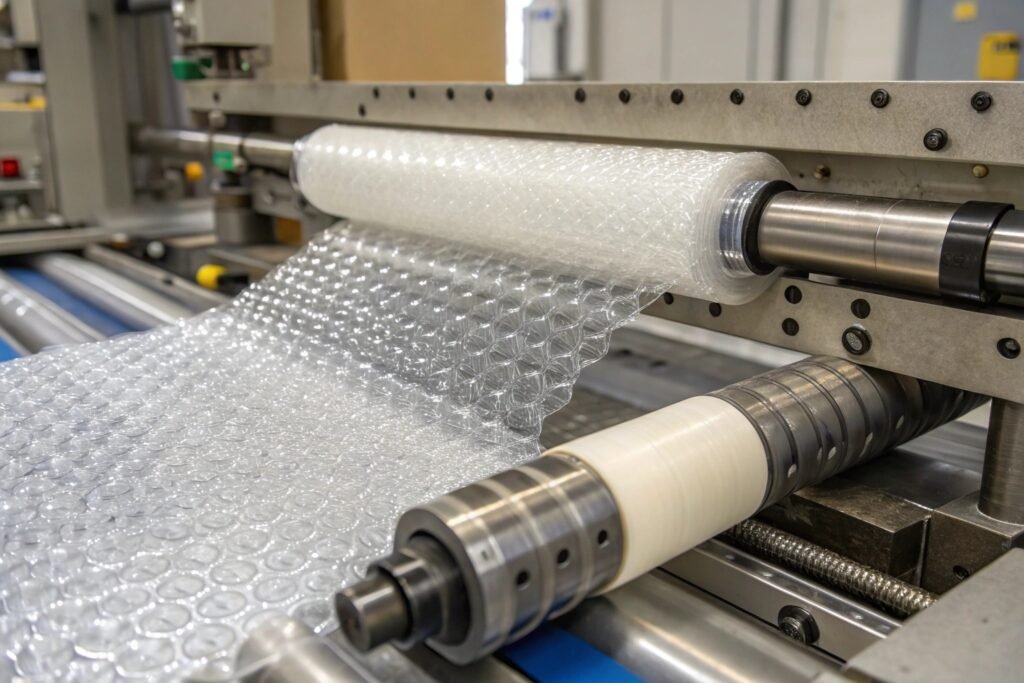
Can You Adjust the Distance Between Punch Lines on a Digital Screen?
Yes. Most modern industrial Bubble wrap cutting machine systems now support digital adjustment for punch spacing and cutting length.
Advanced systems use:
- PLC touch screens
- Servo motor positioning
- Digital feeding control
- Programmable sheet length settings
This allows operators to adjust punch line distance quickly without manually changing mechanical gears.
Advantages of Digital Punch Distance Adjustment
| Feature | Benefit |
|---|---|
| Fast Recipe Changes | Reduced setup time |
| Precise Positioning | Better consistency |
| Multiple SKU Support | Higher flexibility |
| Easy Operation | Lower training requirement |
| Repeatable Accuracy | Stable production quality |
Digital adjustment is especially important for companies producing multiple packaging SKUs.
Dive Deeper: Why Programmable Punch Positioning Improves Efficiency
Modern packaging production changes constantly. Customers often require:
- Different sheet lengths
- Different hole positions
- Multiple perforation patterns
- Customized tear lines
Without digital controls, operators must manually reposition tooling for every product change. This process wastes time and increases setup errors.
How Digital Positioning Works
The machine feeding system uses servo motors and programmable controllers to track material movement precisely.
Operators simply enter:
- Sheet length
- Punch interval
- Hole spacing
- Punch sequence
The system automatically controls feeding distance and punching position.
Example Settings Table
| Product Type | Punch Distance |
|---|---|
| Small Retail Pack | 100 mm |
| Industrial Wrap Sheet | 250 mm |
| Tear-Off Packaging Roll | 500 mm |
This flexibility is extremely useful for packaging manufacturers serving multiple customers.
Benefits of Digital Programming
Faster Production Changeovers
Operators switch products within minutes.
Improved Registration Accuracy
Punch positions remain consistent across long production runs.
Reduced Material Waste
Incorrect hole spacing decreases significantly.
Easier Training
Touch screen systems simplify operation for new workers.
Many HAOXINHE Bubble wrap cutting machine systems also support memory storage for production recipes. Operators can save multiple punching layouts and reload them instantly during future production runs.
This improves both efficiency and repeatability in industrial packaging operations.
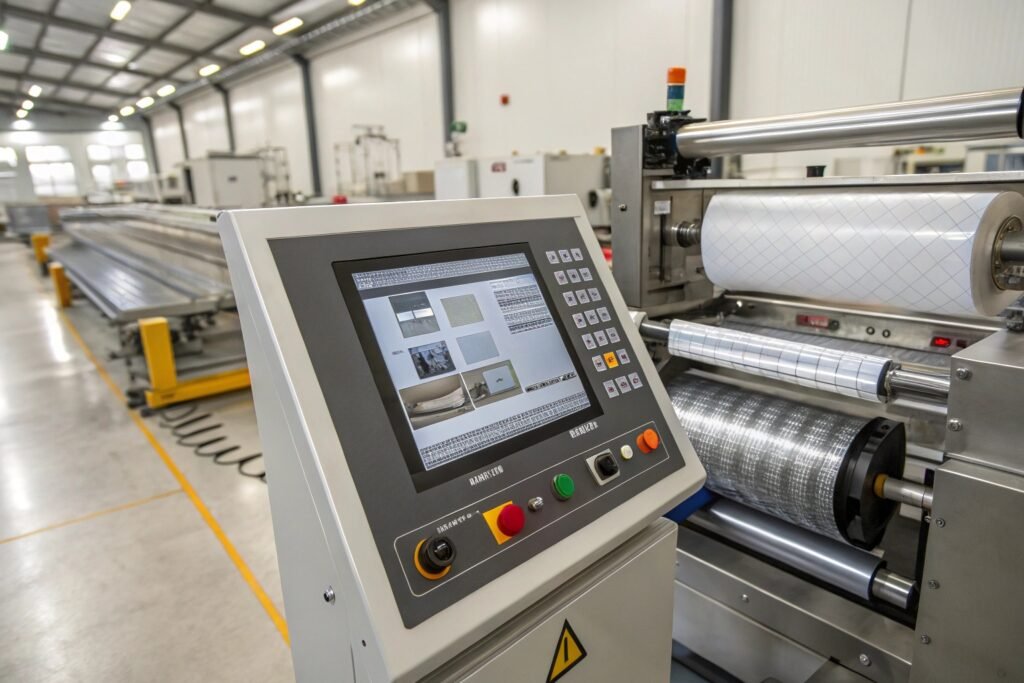
What Types of Custom Blades Are Needed for Adding Easy-Tear Lines?
Easy-tear lines require specialized perforation tooling instead of standard solid cutting blades.
The exact blade type depends on:
- Bubble wrap thickness
- Tear strength requirements
- Hole spacing design
- Material structure
- Production speed
Common Blade Types for Easy-Tear Applications
| Blade Type | Purpose |
|---|---|
| Perforation Blade | Creates tear lines |
| Rotary Punch Blade | High-speed punching |
| Segmented Blade | Adjustable perforation |
| Micro-Tooth Blade | Smooth tearing |
| Custom Die Punch | Special hole patterns |
Different packaging applications require different tear characteristics.
Dive Deeper: Why Blade Design Matters in Bubble Wrap Punching
Many companies underestimate the importance of tooling quality.
The blade directly affects:
- Tear quality
- Material appearance
- Bubble integrity
- Production speed
- Maintenance frequency
Challenges of Punching Bubble Wrap
Bubble wrap is not a flat material. The raised bubble structure creates uneven surface pressure during punching.4
If the blade design is incorrect:
- Bubbles may collapse
- Holes may deform
- Tear lines may fail
- Film may wrinkle
That is why industrial automatic punching cutting machine systems require carefully designed tooling geometry.
Types of Easy-Tear Designs
Micro Perforation
Very small cut intervals create smooth tearing while maintaining sheet strength.
Wide-Gap Perforation
Larger gaps improve roll stability during handling.
Hybrid Punching
Combines holes and perforation lines together.
Tooling Flexibility Is Critical
Many customers change product designs over time.
A good Bubble wrap cutting machine should support:
- Interchangeable dies
- Adjustable perforation spacing
- Custom punch shapes
- Quick blade replacement
Important Blade Selection Factors
| Factor | Why It Matters |
|---|---|
| Blade Hardness | Longer lifespan |
| Tooth Geometry | Tear quality |
| Surface Coating | Reduced sticking |
| Replacement Speed | Lower downtime |
At HAOXINHE, I recommend selecting machines with modular tooling systems because they provide better long-term flexibility for changing production requirements.
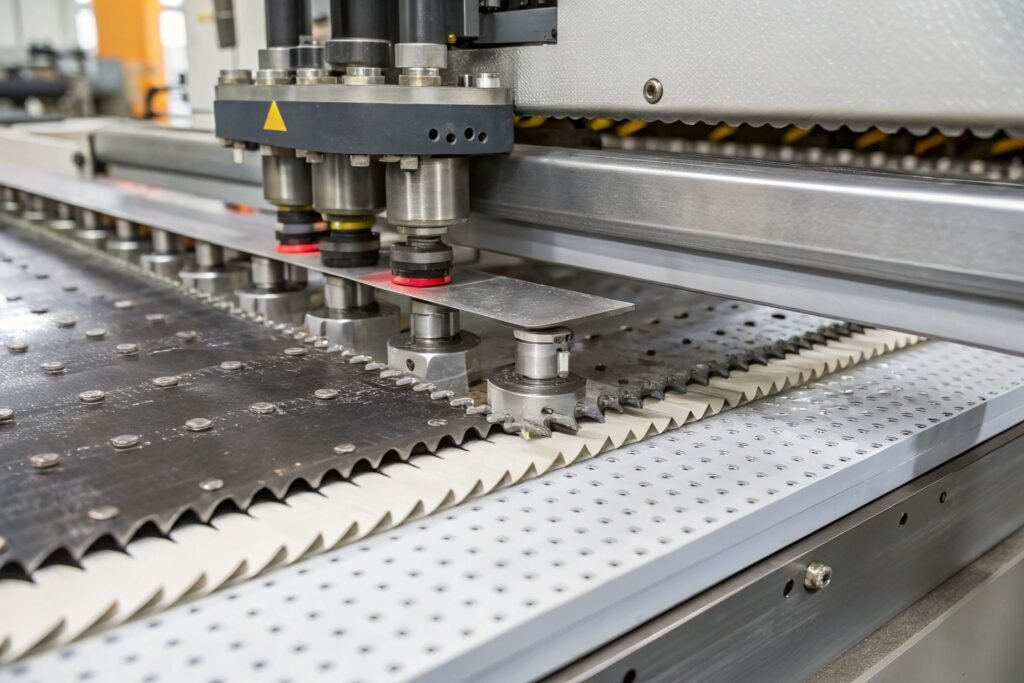
Can One Machine Switch Between Solid Cutting and Punching Modes?
Yes. Many advanced Bubble wrap cutting machine systems support both solid cutting and punching modes within the same machine.
This flexibility is extremely valuable for packaging manufacturers handling multiple product types.
Typical Multi-Mode Functions
| Function | Description |
|---|---|
| Full Sheet Cutting | Complete separation |
| Perforation Punching | Easy-tear lines |
| Hole Punching | Hanging holes |
| Partial Cutting | Controlled tearing |
| Custom Pattern Punching | Special packaging designs |
Some systems allow automatic switching through digital controls, while others require manual tooling replacement.
Dive Deeper: Why Multi-Function Machines Improve Production Flexibility
Packaging markets change rapidly. Customers frequently request:
- New packaging sizes
- Retail display features
- Different perforation layouts
- Custom opening methods
A single-purpose machine quickly becomes limiting.
That is why many factories now prefer multi-function Bubble wrap cutting machine systems.
Advantages of Switching Modes
Lower Equipment Investment
One machine performs multiple operations.
Reduced Floor Space
Factories avoid installing separate punching systems.
Faster Product Development
Operators test different packaging layouts easily.
Higher Production Flexibility
The machine adapts to different customer orders quickly.
Common Switching Methods
| Switching Type | Description |
|---|---|
| Manual Blade Replacement | Lower cost |
| Quick-Change Tooling | Faster setup |
| Servo-Controlled Switching | Automatic operation |
| Modular Punch Stations | Flexible customization |
Important Considerations Before Buying
Registration Accuracy
The machine must maintain alignment during both cutting and punching.
Feeding Stability
Bubble wrap feeding must remain smooth during mode changes.
Pressure Adjustment
Different operations require different cutting pressure.
Operator Interface
Touch screen controls simplify switching between functions.
Many advanced HAOXINHE systems integrate:
- Servo feeding systems
- Automatic tension control
- Digital pressure adjustment
- Programmable punching positions
- Multi-tool compatibility
This allows factories to handle many packaging applications using a single industrial platform.
Key Questions to Ask Before Buying a Custom Punching Machine
Before purchasing a Bubble wrap cutting machine, I always recommend asking suppliers these questions:
| Question | Why It Matters |
|---|---|
| Can the machine punch my exact hole pattern? | Ensures compatibility |
| Does it support adjustable tooling? | Future flexibility |
| Can it process my material thickness? | Prevents feeding issues |
| How accurate is the registration system? | Punch alignment quality |
| Is digital positioning included? | Faster setup |
| What is the tooling replacement cost? | Long-term ownership cost |
| Can you test my sample material? | Reduces purchase risk |
Material testing is one of the most important parts of machine selection.5
Conclusion
Selecting the right Bubble wrap cutting machine with custom punching capability requires much more than comparing machine speed or price.
You must carefully evaluate:
- Punching accuracy
- Feeding stability
- Tooling flexibility
- Pressure control
- Digital programmability
- Material compatibility
- Registration precision
A high-quality automatic punching cutting machine should provide stable cutting, clean perforation, easy operation, and long-term flexibility for changing packaging designs.
At HAOXINHE, I continue developing industrial cutting systems that support modern packaging production requirements with reliable performance and customizable automation solutions.
HAOXINHE Insights
HAOXINHE specializes in advanced industrial cutting and punching equipment for flexible packaging materials and industrial production applications.
My product range includes:
- Bubble wrap cutting machine
- Automatic punching cutting machine
- Webbing ribbon cutting machine
- Hot and cold cutting machine
- High-speed trademark cutting machine
- Protective Foam Cutting Machine
- PVC Edge Banding cutting machine
- Rotary bevel cutting machine
- Different shapes cutting machine
- Computer tube cutting machine
- Wire cutting and stripping machine
- Metal pipe cutting and beveling machine
Why Customers Choose HAOXINHE
| HAOXINHE Advantage | Customer Benefit |
|---|---|
| Custom Tooling Support | Flexible production |
| Servo Feeding Accuracy | Stable punching alignment |
| Modular Blade Systems | Easier product changes |
| Industrial Automation Integration | Higher efficiency |
| Durable Mechanical Design | Long machine lifespan |
| Material Testing Support | Lower purchasing risk |
I always recommend testing actual customer material before machine selection because the safest way to verify punching performance is through real production sample validation.
HAOXINHE continues helping global manufacturers improve packaging efficiency, reduce waste, and achieve stable high-quality production with advanced industrial cutting technology.
-
"Need for Sustainable Packaging: An Overview – PMC – NIH", https://pmc.ncbi.nlm.nih.gov/articles/PMC9609329/. Industry research documents the shift in flexible protective packaging toward value-added features including perforations, custom hole patterns, and retail-ready designs, though specific adoption rates vary by market segment. Evidence role: general_support; source type: research. Supports: the expansion of bubble wrap applications beyond basic cushioning. Scope note: Support is for general industry trends rather than specific bubble wrap statistics ↩
-
"Manufacturing: 4.2 Cutting processes | OpenLearn – Open University", https://www.open.edu/openlearn/science-maths-technology/design-innovation/manufacturing/content-section-4.2. Manufacturing engineering defines full cutting (or through-cutting) as a process where the cutting tool penetrates completely through the material thickness, achieving total separation, as distinguished from kiss-cutting or scoring which creates partial depth cuts. Evidence role: definition; source type: education. Supports: the technical definition of full cutting. ↩
-
"Propagation by Cuttings, Layering and Division", https://pubs.ext.vt.edu/426/426-002/426-002.html. Materials engineering explains that perforation creates stress concentration points through partial thickness cuts, enabling controlled tear propagation along predetermined paths while maintaining sufficient connection strength for handling and processing. Evidence role: mechanism; source type: education. Supports: how perforation enables controlled tearing while maintaining connection. ↩
-
"Contact mechanics – Wikipedia", https://en.wikipedia.org/wiki/Contact_mechanics. Contact mechanics principles establish that non-planar surfaces with discrete raised features create localized stress concentrations and non-uniform pressure distribution during compression or cutting operations, requiring specialized tooling design for consistent processing. Evidence role: mechanism; source type: education. Supports: uneven pressure distribution when processing three-dimensional structures. ↩
-
"[PDF] *Best Practice Guide for Procuring Services, Supplies, and … – EPA", https://www.epa.gov/sites/default/files/2021-03/documents/best-practice-guide-for-procuring-services-supplies-equipment.pdf. Manufacturing engineering guidelines recommend material testing with actual production samples during equipment evaluation to verify processing capability, identify potential issues, and validate performance claims, particularly for specialized materials or critical quality requirements. Evidence role: expert_consensus; source type: education. Supports: the importance of material testing in equipment selection. ↩