How to Solve Static Electricity Problems When Cutting Bubble Wrap Rolls
Static electricity is one of the most common problems in bubble wrap processing. Many packaging companies experience issues when cutting bubble wrap rolls at high speeds. Operators often notice that cut sheets stick to machine slides, cling to rollers, attract dust, or even create small electric shocks during handling.
While static electricity may seem like a minor annoyance, it can reduce cutting accuracy, slow production, increase material waste1, and affect packaging quality. In severe cases, static build-up can disrupt automated feeding systems and create safety concerns for machine operators.
For manufacturers using a Bubble Wrap Cutting Machine, understanding how static electricity develops and how to control it is essential for maintaining efficient production.
In this guide, I will explain why static electricity occurs when cutting bubble wrap rolls, how static elimination bars work, how environmental conditions affect charge accumulation, and what practical steps can safely reduce static discharge.
- Static electricity is a common challenge when processing bubble wrap rolls, causing sheets to cling to machine surfaces, attract dust, disrupt material flow, and reduce cutting efficiency.
- A Bubble Wrap Cutting Machine equipped with static control solutions, such as ionizing bars and proper grounding, helps maintain accurate cutting, smoother discharge, and consistent production performance.
- Environmental factors, especially low humidity and high processing speeds, significantly increase static build-up and should be carefully managed to improve operational stability.
- Combining ionization systems, machine grounding, humidity control, and regular maintenance creates the most effective strategy for reducing static-related production issues.
- By minimizing material sticking, operator discomfort, and packaging defects, effective static management improves productivity, cut quality, and overall packaging efficiency.
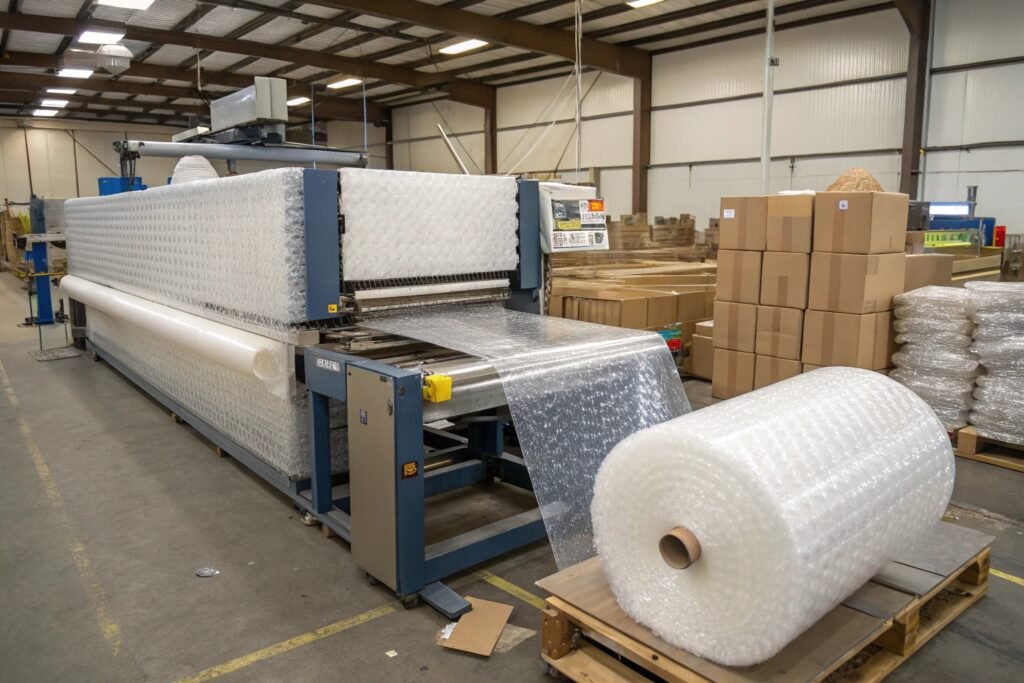
Why Does Static Electricity Occur During Bubble Wrap Cutting?
Bubble wrap is made primarily from polyethylene plastic. Plastic materials are naturally poor conductors of electricity2.
When bubble wrap moves across rollers, guide plates, cutting blades, and machine surfaces, friction occurs. This friction transfers electrons from one surface to another.
The result is static charge accumulation.
The faster the film moves, the greater the opportunity for charge generation3.
Common Sources of Static Generation
| Source | Static Generation Level |
|---|---|
| Unwinding rolls | High |
| Guide rollers | Medium to High |
| Film sliding on metal surfaces | High |
| Cutting operations | Medium |
| Stacking cut sheets | High |
| Dry air environments | Very High |
As production speed increases, static accumulation becomes more noticeable.
This is especially true for:
- Bubble wrap rolls
- Stretch film rolls
- Protective foam sheets
- PE films
- Packaging materials with large surface areas
Many operators first notice static when the material begins behaving unpredictably.
Why Does Static Electricity Cause Cut Sheets to Stick to the Machine Slide?
One of the most frustrating problems in automated cutting systems occurs when freshly cut bubble wrap sheets refuse to separate from machine surfaces.
Instead of falling cleanly into collection trays, sheets cling to slides, guides, conveyors, or discharge tables.
What Causes the Sticking Effect?
Static charges create electrostatic attraction between the bubble wrap and nearby surfaces.
Even when the machine slide is metal, painted coatings or contamination layers may allow static attraction to occur.
Common Symptoms
| Symptom | Likely Cause |
|---|---|
| Sheets cling to discharge slide | Static attraction |
| Cut pieces overlap incorrectly | Static accumulation |
| Material folds during discharge | Electrostatic sticking |
| Irregular stacking | Charge imbalance |
| Increased dust attraction | Static charge |
Dive Deeper: Why Static Sticking Creates Production Problems
Many manufacturers underestimate how much static affects productivity. When bubble wrap sheets stick to machine surfaces, operators often stop the machine to manually separate material. This interrupts production flow and reduces overall output.
The problem becomes worse in high-speed packaging environments. A Bubble Wrap Cutting Machine may cut hundreds or thousands of sheets per hour. If even a small percentage of those sheets stick to discharge components, the entire workflow becomes less efficient.
Static attraction also affects cut accuracy. Sheets that cling to guides may shift position before stacking. This creates uneven piles and can complicate downstream packaging operations.
Another hidden problem involves dust contamination. Charged bubble wrap acts like a magnet for airborne particles. Dust accumulation can affect packaging appearance and increase maintenance requirements.
This is why many industrial packaging facilities invest in dedicated static control systems rather than relying solely on manual interventions.
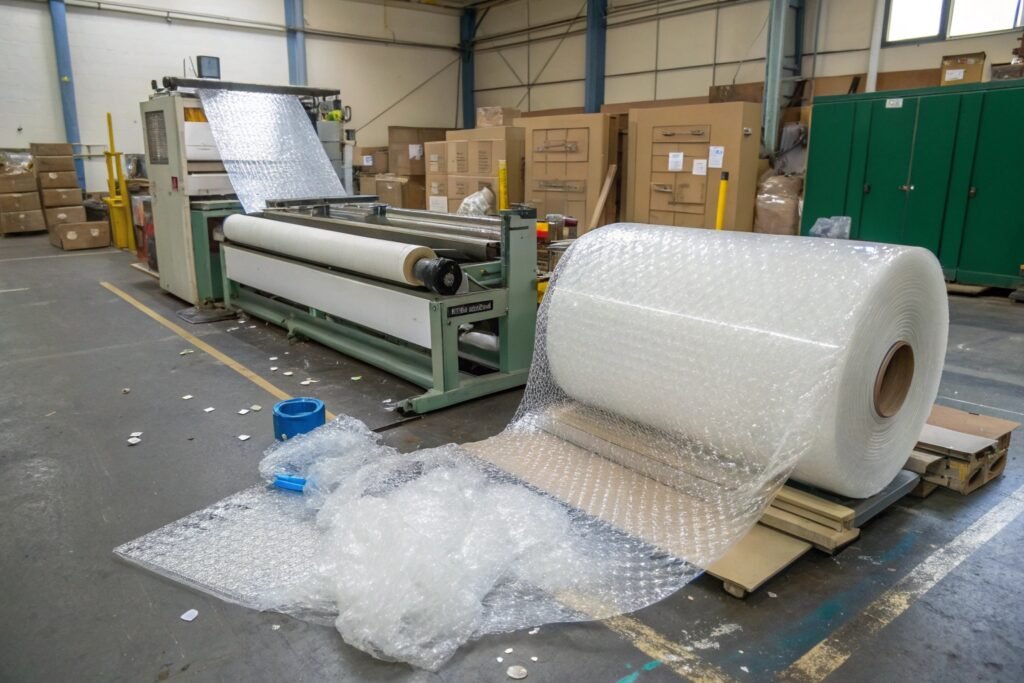
How Do Static Elimination Bars Work on Automatic Film Cutters?
Static elimination bars are among the most effective solutions for controlling electrostatic charges during bubble wrap cutting.
These devices are commonly installed on:
- Bubble Wrap Cutting Machines
- Protective Foam Cutting Machines
- Stretch Film Cutters
- Webbing Ribbon Cutting Machines
- PVC Edge Banding Cutting Machines
Basic Operating Principle
Static elimination bars generate positive and negative ions.
When charged bubble wrap passes near the ionization zone, these ions neutralize the electrical charge on the material surface.
The charge balance prevents static attraction.
Typical Installation Locations
| Location | Purpose |
|---|---|
| Roll exit point | Neutralize charge immediately |
| Before cutting blade | Stabilize material |
| Above discharge slide | Prevent sticking |
| Near stacking area | Improve sheet separation |
Types of Static Elimination Systems
Passive Static Bars
Passive bars do not require external power.
They discharge static using grounded conductive points.
Advantages:
- Lower cost
- Simple installation
- Minimal maintenance
Limitations:
- Less effective at very high speeds
Active Ionizing Bars
Active systems generate ions electronically.
Advantages:
- High effectiveness
- Better performance on fast production lines
- Suitable for automated cutting systems
Limitations:
- Higher initial investment
Dive Deeper: Why Ionization Is the Preferred Industrial Solution
Many companies initially attempt to solve static problems through grounding alone. While grounding is important, it often cannot fully neutralize charges on insulating materials like bubble wrap.
Plastic does not easily transfer charge to ground. As a result, static remains trapped on the material surface.
Ionization works differently. Instead of waiting for charge to dissipate naturally, ionizing bars actively create positive and negative ions that seek out charged surfaces. These ions combine with excess charges and restore electrical balance.
This process happens continuously during production. As bubble wrap moves through the machine, charges are neutralized before they become large enough to cause sticking or operator shocks.
For high-speed production lines, active ionizing bars typically deliver the most reliable results. Many advanced Bubble Wrap Cutting Machines integrate static elimination systems directly into the feeding and discharge sections to maintain stable operation even at high processing speeds.
What Environmental Factors Influence Static Build-Up?
Static electricity does not depend only on the machine itself.
The surrounding environment plays a major role.
Key Environmental Factors
| Factor | Impact on Static |
|---|---|
| Low humidity | Increases static |
| High humidity | Reduces static |
| High material speed | Increases static |
| Dust accumulation | Worsens static effects |
| Poor grounding | Increases static retention |
| Synthetic clothing | Can contribute to static |
The Importance of Humidity
Humidity is often the biggest environmental factor4.
Dry air acts as an electrical insulator5.
When humidity drops, static charges remain trapped on material surfaces longer.
Many facilities notice stronger static problems during:
- Winter months
- Air-conditioned environments
- Low-humidity regions
Recommended Humidity Levels
| Relative Humidity | Static Risk |
|---|---|
| Below 30% | Very High |
| 30%–40% | High |
| 40%–60% | Moderate |
| Above 60% | Lower |
Dive Deeper: Why Humidity Changes Machine Performance
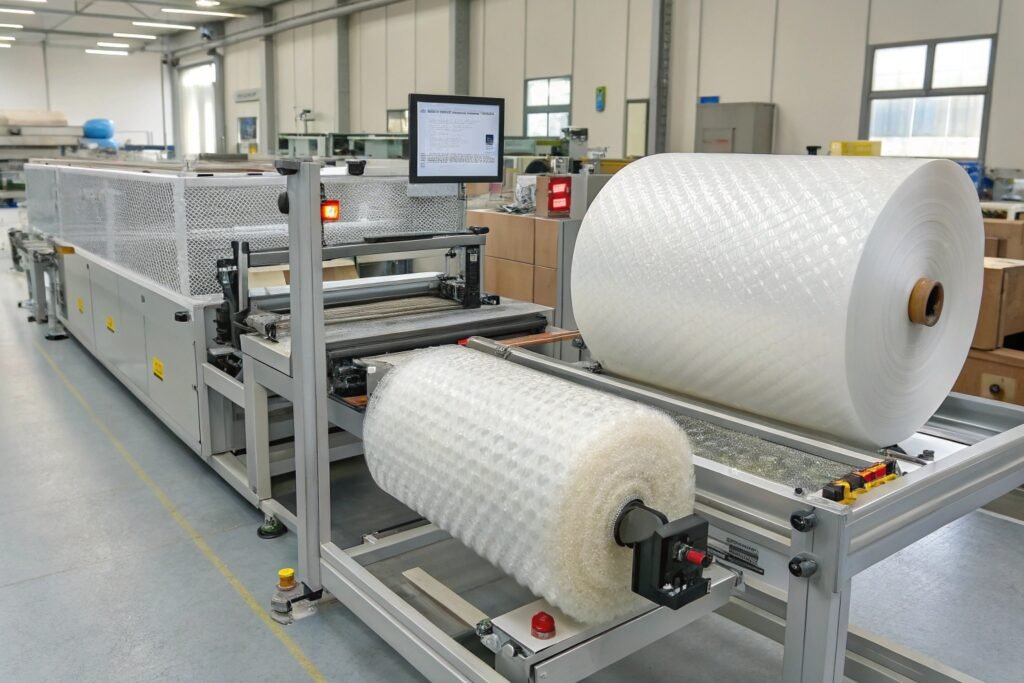
Water molecules naturally help dissipate electrical charges.
When humidity levels are higher, a thin conductive layer forms on many surfaces. This layer allows charges to leak away gradually rather than accumulating.
In very dry conditions, bubble wrap can hold large amounts of static charge. The material may cling to machine components, attract dust, and produce visible discharge sparks.
Many packaging facilities see seasonal fluctuations in machine performance. During summer months, cutting systems may operate smoothly. During winter, the same equipment may experience severe static issues despite no changes in production settings.
Humidity control is therefore an important part of static management. Some facilities install industrial humidification systems to maintain consistent environmental conditions. Others combine humidity control with ionization equipment for maximum effectiveness.
For operations using Bubble Wrap Cutting Machines, Protective Foam Cutting Machines, and Hot and Cold Cutting Machines, maintaining stable humidity can significantly improve overall process reliability.
How to Safely Discharge Built-Up Static Without Shocking the Operator?
Operator safety should always be a priority.
Although most static shocks are not dangerous6, they can be unpleasant and disruptive.
Unexpected shocks may also cause operators to react suddenly around moving machinery.
Safe Static Reduction Methods
Ground the Machine Properly
Ensure all machine frames are connected to a verified grounding system.
This includes:
- Machine body
- Roll stands
- Metal guides
- Static control equipment
Use Grounded Workstations
Grounded tables and discharge surfaces help reduce charge accumulation.
Install Ionization Equipment
Ionizing bars continuously neutralize charges before operators handle the material.
Use Conductive Flooring
Grounded flooring systems help dissipate static safely.
Wear Anti-Static Footwear
Grounded footwear reduces charge accumulation on personnel.
Operator Safety Checklist
| Safety Measure | Benefit |
|---|---|
| Machine grounding | Safe discharge path |
| Ionizing bars | Continuous neutralization |
| Grounded footwear | Reduced operator charging |
| Humidity control | Lower charge generation |
| Regular cleaning | Less dust attraction |
Dive Deeper: Why Multiple Solutions Work Better Than One
Many companies search for a single solution to static electricity. In reality, static control works best when several strategies are combined.
Grounding alone cannot fully neutralize charges on plastic materials. Humidity control helps but may not be enough during high-speed operation. Ionization systems are highly effective but perform best when supported by proper grounding and maintenance.
Successful packaging facilities typically use a layered approach.
First, they reduce static generation by optimizing machine design. Second, they neutralize charges using ionizing bars. Third, they maintain suitable environmental conditions. Finally, they protect operators through grounding and safety procedures.
This combined strategy creates the most stable production environment.
Facilities processing bubble wrap, stretch film, foam sheets, and other flexible materials often report significant improvements after implementing integrated static control systems. Benefits include fewer machine stoppages, cleaner cuts, reduced waste, and improved operator comfort.
Best Practices for Static Control on Bubble Wrap Cutting Machines
| Practice | Expected Result |
|---|---|
| Install ionizing bars | Reduced static attraction |
| Ground machine components | Improved charge dissipation |
| Maintain humidity above 40%7 | Lower static generation |
| Clean rollers and guides regularly | More stable material handling |
| Reduce unnecessary film travel distance | Less charge accumulation |
| Use anti-static accessories when needed | Better long-term control |
| Train operators on static safety | Fewer disruptions |
Conclusion
Static electricity is one of the most common challenges when processing bubble wrap rolls. It can cause sheets to stick to machine slides, attract dust, disrupt automated feeding systems, and create uncomfortable shocks for operators.
The most effective solution is usually not a single adjustment but a combination of strategies. Proper grounding, humidity control, machine maintenance, and static elimination technology all play important roles.
For manufacturers using a Bubble Wrap Cutting Machine, investing in static control systems can improve production speed, cut quality, operator safety, and packaging consistency.
By understanding how static electricity develops and applying the right corrective measures, packaging operations can achieve smoother workflows and more reliable cutting performance.
Insights: Why HAOXINHE Machines Help Control Static-Related Production Problems
HAOXINHE designs cutting equipment for various flexible materials, including bubble wrap, foam, film, webbing, tubing, and packaging products. Stable material handling is a key consideration in machine design.
HAOXINHE Advantages
| Feature | Customer Benefit |
|---|---|
| Custom machine configurations | Adapted to specific materials |
| Stable feeding systems | Reduced material handling issues |
| High-speed automation | Improved productivity |
| Compatible with static control upgrades | Better processing reliability |
| Factory-direct manufacturing | Competitive cost structure |
HAOXINHE product portfolio includes:
- Bubble Wrap Cutting Machine
- Protective Foam Cutting Machine
- Webbing Ribbon Cutting Machine
- Hot and Cold Cutting Machine
- High-Speed Trademark Cutting Machine
- Automatic Punching Cutting Machine
- Round Shape Cutting Machine
- Rotary Bevel Cutting Machine
- Different Shapes Cutting Machine
- PVC Edge Banding Cutting Machine
- Computer Tube Cutting Machine
- Wire Cutting and Stripping Machine
- Metal Pipe Cutting and Beveling Machine
For manufacturers facing static-related cutting challenges, combining high-quality cutting equipment with proper static management practices can significantly improve packaging efficiency, cut consistency, and operator safety.
-
"Biological effects of exposure to static electric fields in humans and …", https://pmc.ncbi.nlm.nih.gov/articles/PMC5393013/. Industrial studies document that uncontrolled static electricity in material handling and converting operations contributes to positioning errors, material adhesion problems, dust contamination, and process interruptions, collectively reducing throughput and increasing defect rates. Evidence role: general_support; source type: paper. Supports: the negative impacts of static electricity on manufacturing operations. Scope note: Specific impact magnitudes vary widely depending on material properties, process parameters, and facility conditions ↩
-
"Electrical and Electrochemical Properties of Conducting Polymers", https://pmc.ncbi.nlm.nih.gov/articles/PMC6432010/. Polyethylene and similar thermoplastic polymers exhibit high electrical resistivity (typically 10^14-10^16 Ω·cm), classifying them as electrical insulators due to the absence of free charge carriers in their molecular structure. Evidence role: definition; source type: encyclopedia. Supports: the insulating properties of polyethylene and plastic materials. ↩
-
"The Relationship between Static Charge and Shape – PMC", https://pmc.ncbi.nlm.nih.gov/articles/PMC7256945/. Studies in web handling demonstrate that electrostatic charge generation increases with material velocity due to higher frequency of contact-separation events and reduced charge dissipation time, with charge density often showing linear or power-law relationships with speed. Evidence role: mechanism; source type: paper. Supports: the correlation between material processing speed and static charge accumulation. Scope note: The exact relationship varies with material properties, surface conditions, and environmental factors ↩
-
"[PDF] The effects of humidity on the electrical properties and carrier …", http://www.chem.ucla.edu/dept/Faculty/schwartz/schwartz_pubs/APL_202101_2023.pdf. Research in electrostatics consistently identifies relative humidity as a critical factor in static charge dissipation, as water molecules adsorbed on surfaces increase surface conductivity and provide charge leakage paths, with effectiveness increasing substantially above 40-50% RH. Evidence role: expert_consensus; source type: paper. Supports: the significant influence of humidity on static electricity accumulation. Scope note: The effect magnitude varies with material type, temperature, and surface characteristics ↩
-
"Dielectric strength – Wikipedia", https://en.wikipedia.org/wiki/Dielectric_strength. Dry air exhibits high electrical resistivity (approximately 10^13-10^16 Ω·m) and functions as an effective insulator, with dielectric strength decreasing as humidity increases due to enhanced ionic conductivity from water vapor and surface moisture films. Evidence role: mechanism; source type: encyclopedia. Supports: the insulating characteristics of dry air. ↩
-
"Electrical Injuries – StatPearls – NCBI Bookshelf – NIH", https://www.ncbi.nlm.nih.gov/books/NBK448087/. Occupational safety guidelines indicate that while static discharges can reach several thousand volts, the extremely low current and brief duration typically result in only discomfort rather than injury, though secondary risks from startle reactions near machinery warrant consideration. Evidence role: expert_consensus; source type: government. Supports: the generally non-hazardous nature of typical static electricity shocks. Scope note: Exceptions exist in explosive atmospheres or for individuals with certain medical devices ↩
-
"Make Humidification Adjustments – Energy Star", https://www.energystar.gov/products/data_center_equipment/16-more-ways-cut-energy-waste-data-center/make-humidification-adjustments. Industry standards for electrostatic discharge control, such as ANSI/ESD S20.20, typically recommend maintaining relative humidity between 30-70%, with levels above 40% providing measurably improved charge dissipation for most materials and processes. Evidence role: expert_consensus; source type: institution. Supports: recommended humidity levels for static electricity control. Scope note: Optimal ranges may vary based on specific materials, processes, and other environmental factors ↩