How does a Solar Panel EVA Gasket Cutting Machine work for photovoltaic module production?
When people talk about solar panel manufacturing, they often focus on solar cells, glass, and lamination equipment. However, the EVA cutting process is also a very important step because EVA directly affects module protection, durability, and final product quality.
A Solar Panel EVA Gasket Cutting Machine is designed to prepare photovoltaic EVA materials with accurate dimensions before the lamination process.
In photovoltaic module production, EVA works as an encapsulation material. The U.S. Department of Energy’s solar manufacturing overview describes how encapsulant sheets are placed around solar cells before lamination.1 It protects solar cells by providing:
- Strong bonding
- Electrical insulation
- Moisture protection
- Mechanical protection
- Long-term stability
A small cutting error in EVA preparation can create problems later, including:
- Uneven encapsulation
- Poor edge protection
- Material waste
- Lamination defects
- Lower module quality
At HAOXINHE, I often explain to customers that an EVA cutting machine is not only a cutting device. It is an important part of the photovoltaic production process.
The machine must work together with:
- Glass loading systems
- Solar cell stringing equipment
- Layup systems
- Laminators
- Inspection systems
The main goal is simple:
Prepare EVA sheets with accurate size, stable position, and consistent quality before lamination.
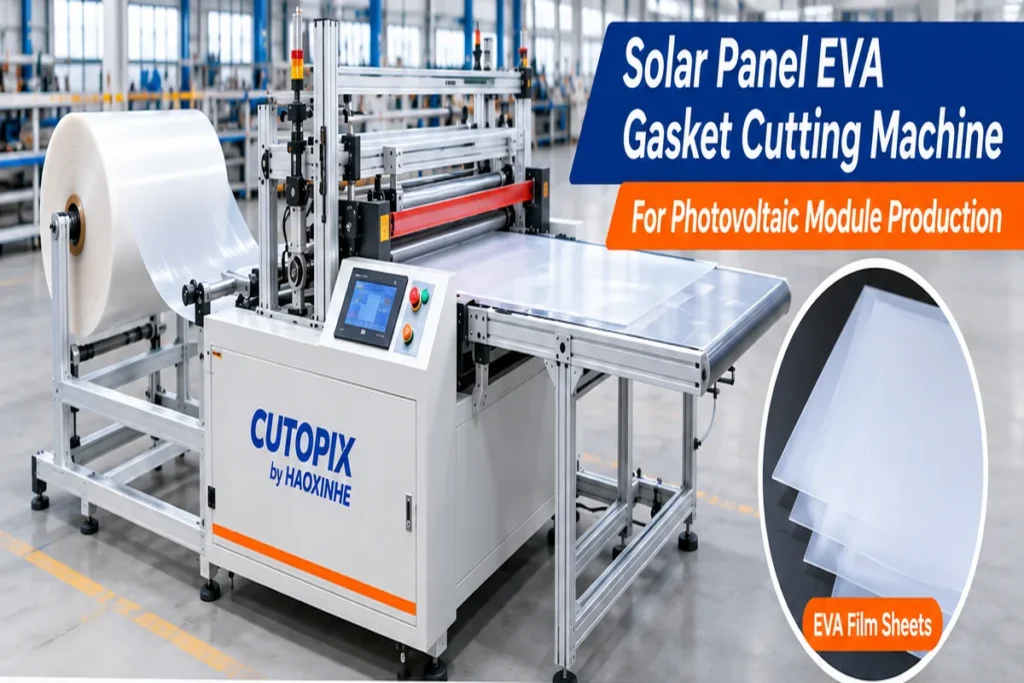
What are the key cutting steps and accuracy requirements for EVA gasket processing?
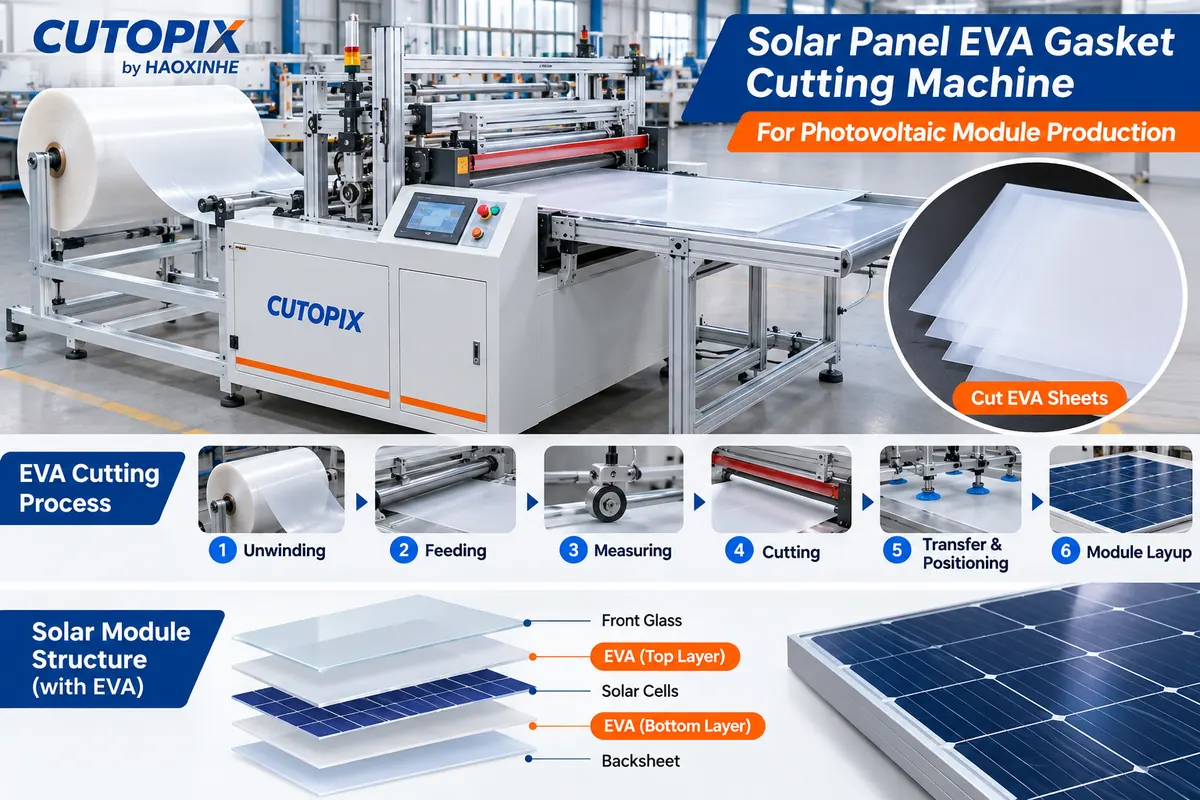
A Solar Panel EVA Gasket Cutting Machine usually follows several important steps:
- EVA material unwinding
- Material feeding
- Length measurement
- Cutting
- Transfer and positioning
- Module layup
Each step affects final solar module quality.
A high-quality EVA cutting process requires:
- Stable material tension
- Accurate feeding
- Clean cutting edges
- Correct dimensions
- Reliable positioning
1. EVA material unwinding and tension control
The first step is supplying EVA material from a roll.
The machine uses an unwinding system to release photovoltaic EVA film smoothly.
The purpose of the unwinder is to keep the material:
- Flat
- Stable
- Properly tensioned
Without good tension control, EVA may experience:
- Wrinkles
- Stretching
- Material movement
- Uneven feeding
| Material problem | Production impact |
|---|---|
| Wrinkles | Poor module appearance |
| Stretching | Incorrect dimensions |
| Loose tension | Position errors |
| Excess tension | EVA deformation |
A good unwinding system helps maintain stable material conditions before cutting.
For photovoltaic production, material stability is very important because module sizes are usually standardized and require repeatable accuracy.
2. Servo-controlled EVA feeding
After unwinding, the EVA film moves through the feeding system.
Modern machines often use servo motors because they provide accurate movement control.
The feeding system controls:
- EVA length
- Feeding speed
- Cutting position
- Production rhythm
| Feeding component | Function |
|---|---|
| Servo motor | Controls precise movement |
| Roller system | Transfers EVA material |
| Encoder | Measures distance |
| Controller | Stores production parameters |
A servo feeding system allows one machine to process different photovoltaic module sizes.
Operators can change settings according to:
- Module length
- Module width
- EVA sheet specification
This improves production flexibility.
3. EVA cutting process
The cutting unit is the core part of the machine.
Depending on machine design, EVA cutting may use:
- Knife cutting
- Die cutting
- Punching systems
The cutting system creates EVA sheets according to the required module size.
The machine must control:
- Cutting length
- Cutting width
- Edge quality
- Shape accuracy
| Cutting requirement | Importance |
|---|---|
| Accurate length | Matches module size |
| Clean edge | Prevents material problems |
| Stable dimensions | Improves lamination quality |
| Low waste | Reduces production cost |
For solar module production, inaccurate EVA size may cause:
- Insufficient cell coverage
- Excess material overlap
- More trimming waste
4. EVA transfer and positioning
After cutting, the EVA sheet needs to move to the assembly area.
Automatic systems may use:
- Vacuum suction
- Conveyor transfer
- Pick-and-place systems
The purpose is to keep EVA:
- Flat
- Clean
- Correctly positioned
| Transfer method | Advantage |
|---|---|
| Vacuum handling | Reduces surface damage |
| Conveyor system | Supports continuous production |
| Automatic positioning | Improves consistency |
Manual handling may introduce:
- Finger marks
- Contamination
- Position errors
Automation helps improve production stability.
5. First EVA layer placement in solar module assembly
In a photovoltaic module, EVA is placed between different layers.
The typical structure is described in the U.S. Department of Energy’s PV manufacturing guide.1
| Layer | Function |
|---|---|
| Front glass | Protects module surface |
| EVA layer | Encapsulates solar cells |
| Solar cells | Generate electricity |
| EVA layer | Provides additional protection |
| Backsheet or rear glass | Protects rear side |
The first EVA sheet is placed between the glass and solar cells.
The EVA cutting machine must provide accurate dimensions because the EVA needs to fully cover the active area.
Incorrect EVA size can create:
- Exposed areas
- Uneven edges
- Lamination problems
6. Second EVA sheet cutting and placement
The second EVA layer is placed above the solar cells.
This layer also requires accurate cutting.
Important requirements include:
- Correct size
- Stable thickness
- Clean surface
- Proper alignment
| EVA quality factor | Effect on module |
|---|---|
| Correct size | Better encapsulation |
| Clean surface | Lower contamination risk |
| Stable thickness | Better lamination |
| Accurate position | Improved appearance |
The cutting machine helps ensure every module receives consistent EVA coverage.
7. Synchronization with the photovoltaic production line
In modern solar factories, EVA cutting equipment usually works as part of an automated production line.
The machine needs to communicate with:
- Glass loading systems
- Cell stringing machines
- Layup systems
- Laminators
This synchronization helps maintain production speed.
| Production equipment | Relationship with EVA cutter |
|---|---|
| Glass loading | Provides base material |
| Cell stringer | Provides solar cell layout |
| Layup system | Receives EVA sheet |
| Laminator | Completes encapsulation |
A well-designed EVA cutting system helps factories maintain stable production flow.
8. Accuracy requirements for EVA cutting
Accuracy is one of the most important requirements.
A solar module factory usually checks:
- Length accuracy
- Width accuracy
- Position accuracy
- Edge quality
| Accuracy factor | Why it matters |
|---|---|
| Cutting length | Matches module size |
| Sheet position | Prevents assembly errors |
| Edge quality | Reduces lamination problems |
| Repeatability | Maintains production consistency |
The machine should maintain accuracy during long production hours. For broader PV module manufacturing quality practices, see IEC 62941:2019, which addresses quality systems and control of materials and processes in module manufacturing.2 This is a module-manufacturing standard, not a certification claim for this cutting machine.
This requires:
- Stable mechanical structure
- Accurate sensors
- Reliable feeding system
- Regular maintenance
9. EVA stack enters the lamination process
After EVA cutting and placement, the module stack enters the laminator.
The typical structure before lamination is:
- Glass
- EVA
- Solar cells
- EVA
- Backsheet or rear glass
During lamination:
- Air is removed
- EVA softens
- EVA bonds the layers together
The lamination process creates the final protected solar module structure. For the wider context of PV module design qualification and testing, see IEC 61215-1:2021.3 This standard does not itself specify the cutting-machine accuracy described above.
A stable EVA cutting process helps reduce:
- Air bubbles
- Material shortage
- Edge problems
- Rework
10. Trimming and final module finishing
After lamination, extra EVA material is trimmed.
The module then continues through:
- Edge sealing
- Frame installation
- Junction box installation
- Electrical testing
- Visual inspection
- Packaging
Accurate EVA cutting helps reduce excess trimming.
This creates:
- Cleaner module edges
- Less material waste
- Better production efficiency
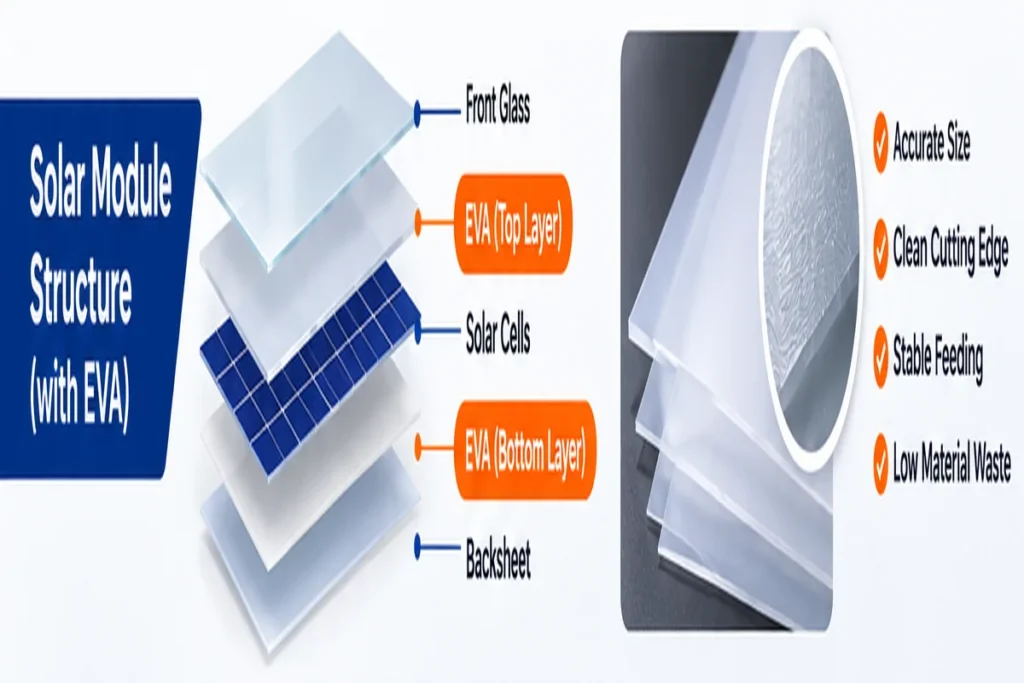
What are the main benefits of using an accurate EVA cutting machine?
A professional Solar Panel EVA Gasket Cutting Machine helps factories achieve:
| Benefit | Production improvement |
|---|---|
| Accurate cutting | Better module consistency |
| Stable feeding | Less material waste |
| Automation | Lower labor cost |
| Repeatable settings | Faster production change |
| Clean cutting | Better final quality |
For photovoltaic manufacturers, these benefits directly affect production cost and product reliability.
Insights: How HAOXINHE supports photovoltaic and industrial cutting solutions
At HAOXINHE, I understand that every factory needs reliable production equipment.
My customers usually care about:
- Cutting accuracy
- Machine stability
- Production efficiency
- Customization ability
- Delivery reliability
I provide customized cutting machine solutions for different industries, including:
- Packaging
- Printing
- Labels
- Plastic products
- Foam products
- Photovoltaic-related materials
- Industrial materials
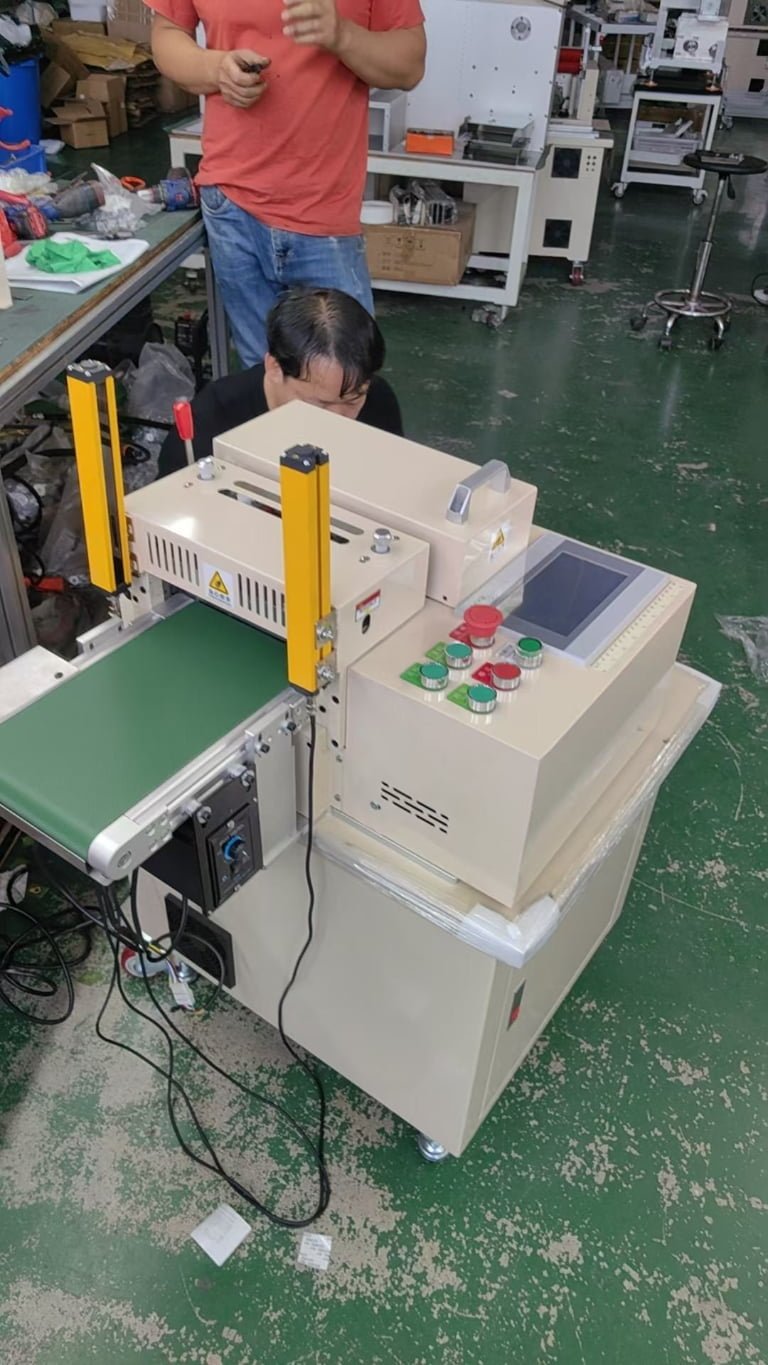
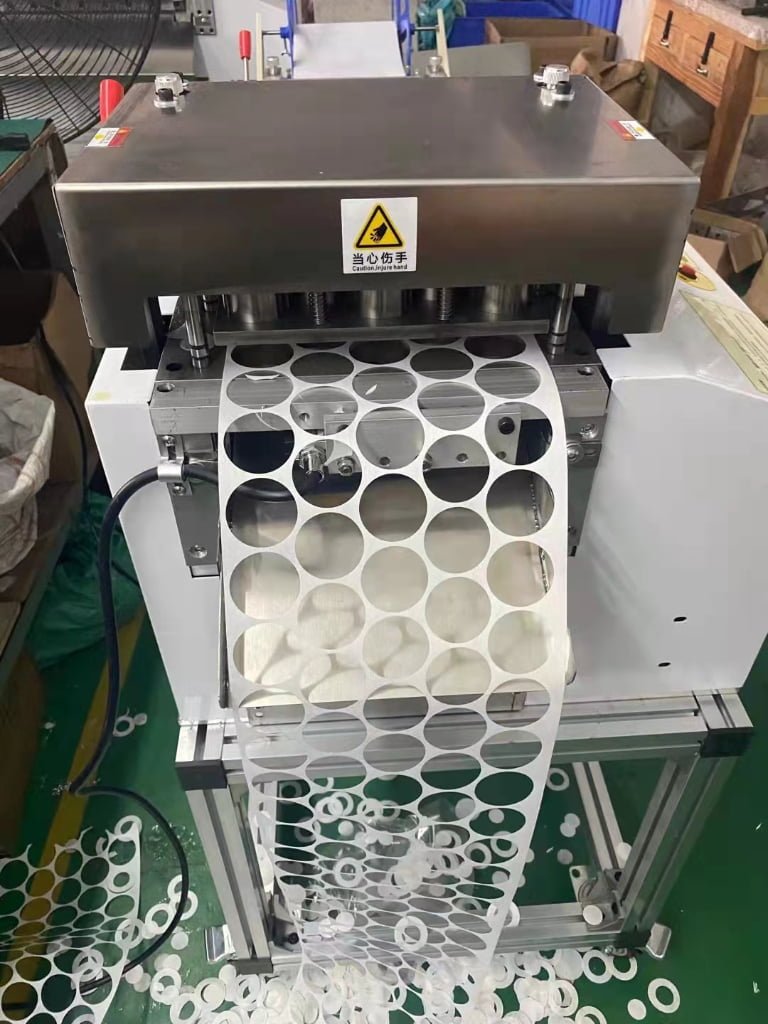
For customers who need small EVA gasket components with punched shapes or holes, see the CUTOPIX HX-200DK-B2 Solar PV EVA Gasket Punching & Cutting Machine. Important: this gasket-punching application is different from cutting wide EVA encapsulation film sheets for module lamination; the required machine configuration must be confirmed from the actual material and finished dimensions.
You can also browse CUTOPIX cutting machines to compare related material-processing solutions.
My related cutting equipment includes:
- Webbing tape cutting machine
- Hot and cold cutting machine
- High-speed trademark cutting machine
- Automatic punching cutting machine
- Round shape cutting machine
- Rotary bevel cutting machine
- Different shapes cutting machine
- Computer tube cutting machine
- Wire cutting and stripping machine
- Metal pipe cutting and beveling machine
- Webbing ribbon cutting machine
- Bubble wrap cutting machine
- PVC Edge Banding cutting machine
- Protective Foam Cutting Machine
I believe a successful cutting solution should help factories improve:
- Product quality
- Production speed
- Material utilization
- Long-term operating efficiency
For photovoltaic module production, EVA cutting accuracy is an important foundation for stable solar panel manufacturing.
A reliable EVA cutting machine does not only prepare material.
It helps factories create better solar modules with consistent quality and lower production waste.
Request a Cutting Solution for Your EVA Material
Are you cutting EVA encapsulation film into module-size sheets, or punching smaller EVA gasket components? Send CUTOPIX your material photos, roll width, thickness, required cut dimensions, target output, and any drawings. We can review the application and discuss a suitable machine configuration before quotation.
Explore the HX-200DK-B2 EVA Gasket Punching & Cutting Machine | Contact CUTOPIX
References
-
U.S. Department of Energy, Solar Photovoltaic Manufacturing Basics. https://www.energy.gov/cmei/systems/solar-photovoltaic-manufacturing-basics — describes encapsulant layers and PV module assembly. ↩ ↩
-
International Electrotechnical Commission, IEC 62941:2019 — Terrestrial photovoltaic (PV) modules — Quality system for PV module manufacturing. https://webstore.iec.ch/en/publication/61932 — manufacturing quality and process controls. ↩
-
International Electrotechnical Commission, IEC 61215-1:2021 — Terrestrial photovoltaic (PV) modules — Design qualification and type approval — Part 1: Test requirements. https://webstore.iec.ch/en/publication/61345 — module design qualification, not machine certification. ↩