What safety standards should a PV EVA gasket die cutting machine meet?
A PV EVA gasket die cutting machine should meet the machinery and workplace safety requirements applicable at its destination. For EU deliveries, check the machinery legislation in force when the machine is placed on the market or put into service, and request the applicable declaration of conformity. For U.S. installations, review OSHA machine guarding and hazardous-energy rules and determine whether a press-specific rule applies. Common engineering references include ISO 12100 for risk assessment, ISO 14120 and ISO 14119 for guards and interlocks, ISO 13849-1 for safety-related controls, ISO 13850 for emergency stop and IEC 60204-1 for electrical equipment. The exact standards depend on the press drive, access points, feed and collection modules, and intended operating tasks.[1][2][3][4][5][6]
Which safety requirements apply at the destination?
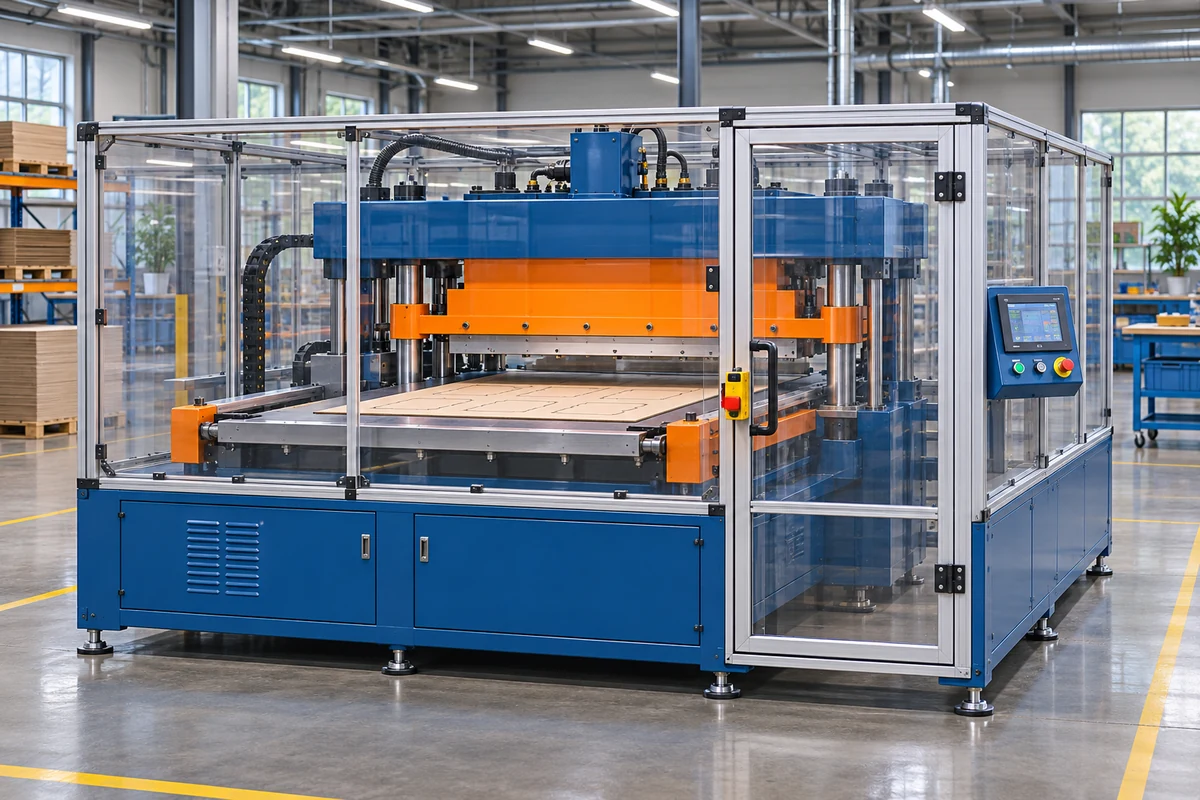
Start with the destination and the equipment boundary. A machine can ship as a standalone roll-fed cutter, a press with an unwind and collection system, or part of a line assembled by an integrator. In the purchase specification, name the parties responsible for the delivered machine and for the completed installation. Include the equipment connected after shipment, such as a powered reel stand, a scrap rewinder or a shared access gate. Their location and control interfaces can change the hazards and the scope of validation.
| Destination | What to check | What to request |
|---|---|---|
| European Union | Directive 2006/42/EC generally applies before 20 January 2027. Regulation (EU) 2023/1230 generally applies from that date, with transitional provisions.[1][2] | Confirm the applicable conformity route, signed EC or EU Declaration of Conformity for complete machinery, CE marking, instructions and the standards used. |
| United States | Review OSHA 29 CFR 1910.212 for general machine guarding and 1910.147 for covered servicing and maintenance. Check 1910.217 if the machine is a covered mechanical power press.[3][4][7] | Request guarding and energy-isolation details. Ask the receiving facility to confirm its electrical acceptance and any inspection or listing requirements for the exact configuration. |
| Other destinations | Confirm the machinery, electrical and workplace rules with the importer and receiving facility. | Request a model-specific compliance plan, including required documents, language and installation responsibilities. |
For an EU project scheduled near the transition, record the expected placing-on-the-market or putting-into-service date, as applicable. A quotation date or factory test date alone is insufficient to settle the question. Where the supplier relies on a harmonised standard, check the exact EN reference and edition against the applicable Official Journal listing and any restrictions. A current ISO catalogue entry and an EU harmonised reference can have different dates. For U.S. projects, check the scope of the OSHA press rule against the actual mechanism. That rule expressly excludes hydraulic and pneumatic power presses from its scope. General guarding and applicable hazardous-energy obligations still need review for those machines.[7][8]
Which machinery standards should the supplier evaluate?
ISO 12100 gives the design team a method for assessing and reducing risk over the machine life cycle. Ask the supplier to explain the safety design for normal production and for the tasks that bring operators closer to moving parts. On a roll-fed gasket cutter those can include threading a roll, rethreading after a break, clearing punch slugs, changing dies and troubleshooting the feed. Consider access from the sides, under the machine, and through the inlet and outlet. A guard over the die area may leave an accessible pinch point at the rollers or a path from the output chute back to a moving component.[5]
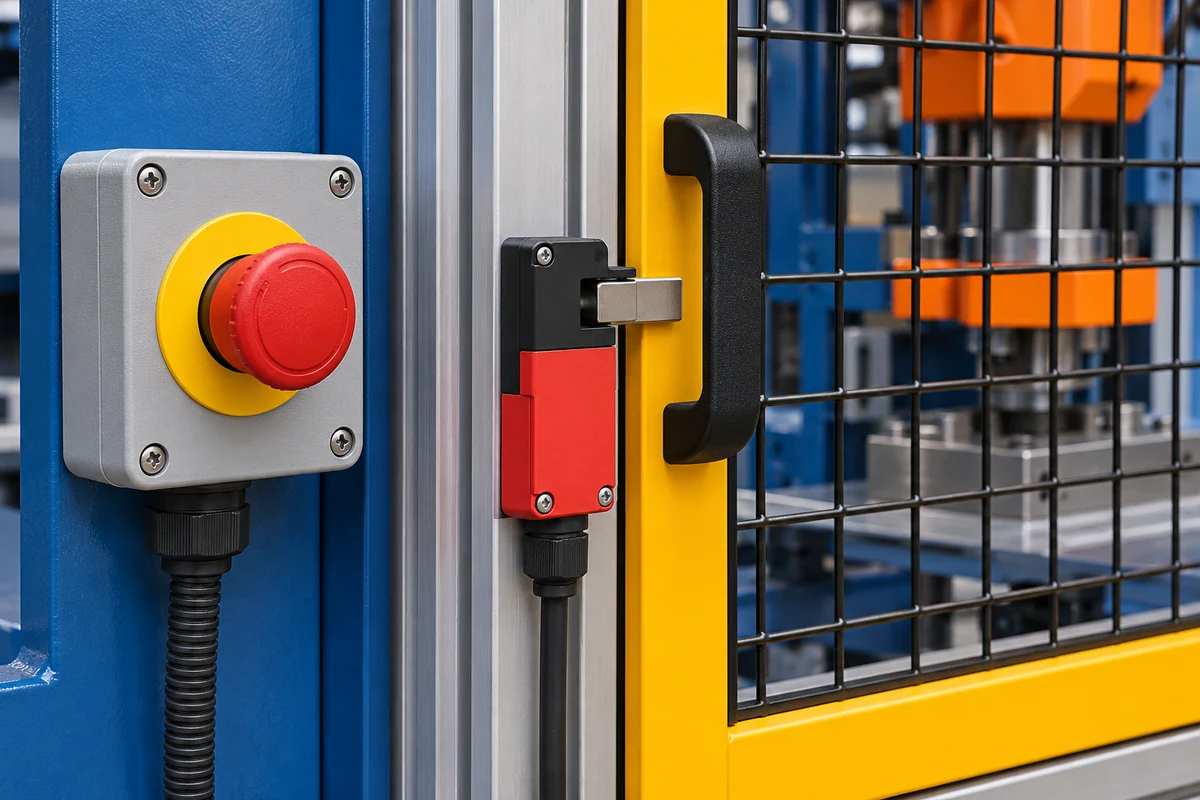
| Reference | What it addresses | What to ask the supplier |
|---|---|---|
| ISO 12100 | Risk assessment and risk reduction.[5] | Which tasks, hazards, protective measures and residual risks does the assessment cover? |
| ISO 14120 and ISO 14119 | Guard design and selection of interlocking devices associated with guards.[9][10] | Which guards are fixed, which are opened routinely and how is access controlled until motion is safe? |
| ISO 13849-1 | Design of safety-related parts of control systems.[6] | What required performance level (PLr) did the assessment determine for each relevant safety function, and how was the implemented function verified and validated? |
| ISO 13850 | Design principles for the emergency stop function.[11] | Which movements does each device stop, and what intentional actions are needed before restarting? |
| IEC 60204-1 | Electrical equipment of machines.[12] | How do the supply, protective bonding, disconnect and control cabinet match the site and wiring drawings? |
| ISO 13855, where applicable | Positioning of safeguards relative to a person’s approach.[13] | What measured stop time and application conditions support the positioning of presence-sensing safeguards? |
Ask whether a machine-specific standard covers the exact machine. For example, ISO 16092-1 describes presses intended for cold metal or material partly made of cold metal, including such presses that can also work other sheet materials. A foam-only cutter requires a scope check before using that standard as the machine-specific basis. Have the supplier state the edition, the scope rationale and how any gaps are addressed.[14] For safety controls, review the complete function from sensing to the final device that stops or prevents motion. The rating of one switch or safety relay alone cannot establish the performance of the installed function.
What should guarding and safe access cover?
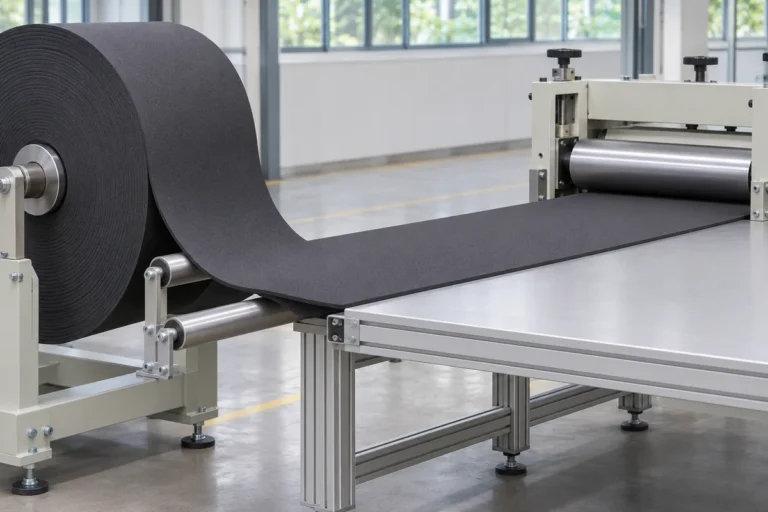
Map the hazards from the reel to the finished part. Unwind spindles, driven rollers, the punch and blade, waste handling and discharge can each require a different protective measure. The equipment layout should make routine tasks possible with the intended safeguards in place. If the operator must frequently open a cover to clear a trim strip, give the supplier that detail before guard design starts. Access frequency and the time it takes moving parts to stop affect how the access point should be protected.
Ask what happens when an interlocked door opens, including which drives stop and how the machine prevents a new stroke. Where a person can reach a hazard before the danger has ceased, have the design team assess guard locking or another suitable protective measure. Confirm how resetting the safety function interacts with the separate start command. Loss and restoration of power or air should be included in the safety review. A missing-material sensor primarily responds to the production process unless the supplier has specifically designed and validated it as part of a safety function. An emergency stop provides a complementary protective measure. Routine access and energy isolation require their own provisions.[5][10][11]
Plan maintenance access around every relevant energy source. Electrical drives, trapped air or hydraulic pressure, gravity-loaded tooling and reels under tension can remain hazardous after a normal stop. Ask for identified isolation points, instructions for relieving or securing stored energy, and a safe way to support tooling where needed. For covered work in a U.S. plant, incorporate the machine information into the employer’s energy-control procedures and training under OSHA 1910.147.[4]
What evidence should international buyers require before shipment?

Agree on documentary and functional acceptance before signing the purchase order. Identify the exact model, modules, drawings and control version in the contract. Request an operating and maintenance manual, electrical and applicable fluid-power schematics, a list of safety functions and appropriate validation evidence. For an EU order, check the declaration against the delivered machine identification and applicable legislation. If the supplier provides reports for components, record which components they cover and ask for machine-level evidence on the assembled system.[1][2]
| Acceptance item | Evidence to request | When to review |
|---|---|---|
| Physical guarding | Layout drawings and inspection of access routes around feed, die and discharge | Design approval and factory acceptance |
| Guard interlock, stop and restart | Documented functional test for the specified operating modes and restart behavior | Factory acceptance, then repeat affected checks after integration |
| Emergency stop | Test results showing the agreed stop response and reset behavior | Factory and site acceptance |
| Energy isolation | Marked isolation points and instructions for stored energy and die changes | Before operator and maintenance training |
| Electrical and line interfaces | Drawings, test records as applicable, and verified behavior of shared stops or gates | Factory review and site acceptance after connections |
| Identification and declarations | Model, serial identification, applicable signed declaration and instruction package | Before shipment release |
Use a qualified person to plan and witness functional testing. Define safe test methods and expected responses in advance. A factory acceptance test can check the shipped system, while site acceptance can confirm how it behaves after installation with its final production modules, access routes and utilities. If a guard layout or control interface changes in transit or during integration, identify the affected functions and review the validation again. Log open items with a responsible person and resolve safety-critical items before equipment is released to production.
Insights: How HAOXINHE reviews PV EVA gasket machine requirements
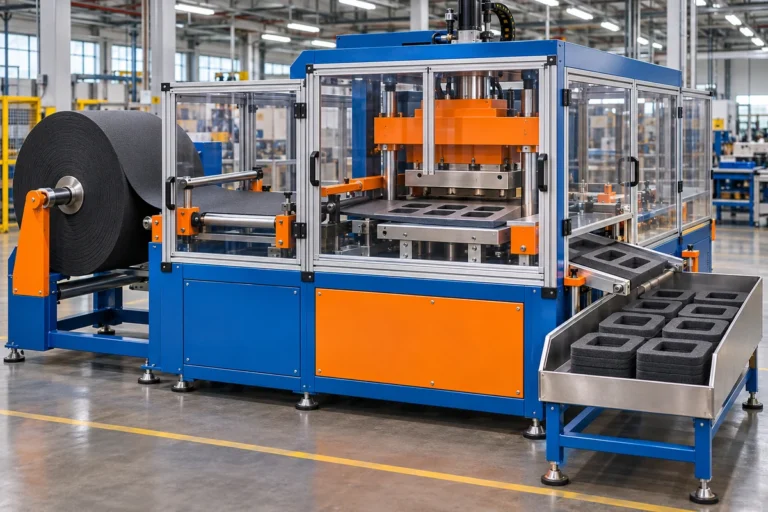
The CUTOPIX HX-200DK-B2 product page describes an automatic roll-fed punching and cutting machine for small, thin flexible gasket components. For a quotation, share your material type, thickness, roll width and weight, drawing, target output, destination and line layout. Include the operating tasks that require access and any safeguarding or documentation requirements your facility has established. This information lets us evaluate the material feed and tooling and discuss the requested scope for the quoted configuration.[15]
If a project adds a powered unwind, rewinder or another machine, send its layout and a description of shared safety functions. Identify who integrates those modules and who validates the installed line. Buyers comparing other formats can review the CUTOPIX machine range. Send your specification through the CUTOPIX contact page or email cherryhaoxinhesz@gmail.com to discuss sample testing, configuration and documentation.
Frequently asked questions
Is there a separate safety standard just for PV EVA gasket cutters?
Start from the machine’s design and use. A roll-fed punch-and-cut machine, hydraulic flatbed press and rotary converter can have different hazards and applicable standards even if they produce the same part. PV component qualification addresses a separate question about the gasket or finished assembly. A vendor should be able to explain the standards selected for the machine itself.
Does every access door need the same interlock?
The required protection depends on what the door gives access to, whether the danger can persist after a stop signal, and how frequently the door is opened. Fixed guards, interlocking and guard locking serve different access conditions. Ask the supplier to explain how each routinely opened guard relates to the risk assessment and what happens if the door is opened during operation.
Is a CE mark enough for a U.S. installation?
A U.S. buyer should evaluate OSHA workplace requirements and the installation’s applicable electrical acceptance criteria independently. Ask your facility team to review the enclosure, electrical documentation, guarding and hazardous-energy procedures for the location and configuration before delivery.[3][4]
What should go on the purchase specification?
Record the destination, exact press architecture, linked equipment, operating and maintenance access, applicable requirements and evidence due before shipment. Require the supplier and receiving team to agree on how they will verify the safety functions at the factory and at the site. A sample-cut video can confirm the result on your material. A documented safety acceptance test checks how the machine responds when someone needs to gain access, stop the process or isolate energy.
References
- EUR-Lex — Directive 2006/42/EC on machinery, consolidated text. Source
- EUR-Lex — Regulation (EU) 2023/1230 on machinery, consolidated text. Source
- OSHA — 29 CFR 1910.212, General requirements for all machines. Source
- OSHA — 29 CFR 1910.147, The control of hazardous energy. Source
- ISO — ISO 12100:2010, Risk assessment and risk reduction. Source
- ISO — ISO 13849-1:2023, Safety-related parts of control systems. Source
- OSHA — 29 CFR 1910.217, Mechanical power presses. Source
- EUR-Lex — Commission Implementing Decision (EU) 2026/2015 on harmonised machinery standards supporting Directive 2006/42/EC. Source
- ISO — ISO 14120:2015, Fixed and movable guards. Source
- ISO — ISO 14119:2024, Interlocking devices associated with guards. Source
- ISO — ISO 13850:2015, Emergency stop function. Source
- IEC — IEC 60204-1, Electrical equipment of machines. Source
- ISO — ISO 13855:2024, Positioning of safeguards. Source
- ISO — ISO 16092-1:2017, Presses, general safety requirements. Source
- CUTOPIX — Solar PV EVA Gasket Punching & Cutting Machine HX-200DK-B2. Source