How to Operate an Automatic Webbing Angle Cutting Machine Safely?
Safety is the first step to getting stable production, high-quality cuts, and a long machine life. I always believe that even the best automatic webbing angle cutting machine cannot deliver good results if operators ignore safety rules. Many production problems, machine failures, and workplace accidents happen because people skip simple safety checks.1
If I want continuous production with fewer machine stoppages, I always make safety part of my daily routine. A few minutes spent checking the machine before production can save hours of downtime later.
Whether I operate a webbing tape cutting machine, hot and cold cutting machine, high-speed trademark cutting machine, or an automatic webbing angle cutting machine, the same safety principles always apply.
Safe operation of an automatic webbing angle cutting machine is essential for maintaining production efficiency, cutting accuracy, and long-term equipment reliability.2 Following proper safety procedures—including pre-operation inspections, correct parameter settings, routine maintenance, and continuous monitoring—helps reduce accidents, minimize downtime, and extend machine life. Whether using hot cutting or cold cutting, trained operators and consistent safety practices ensure stable performance, lower maintenance costs, improved product quality, and reliable results in high-volume webbing and narrow fabric manufacturing.
Why Is Safe Operation So Important?
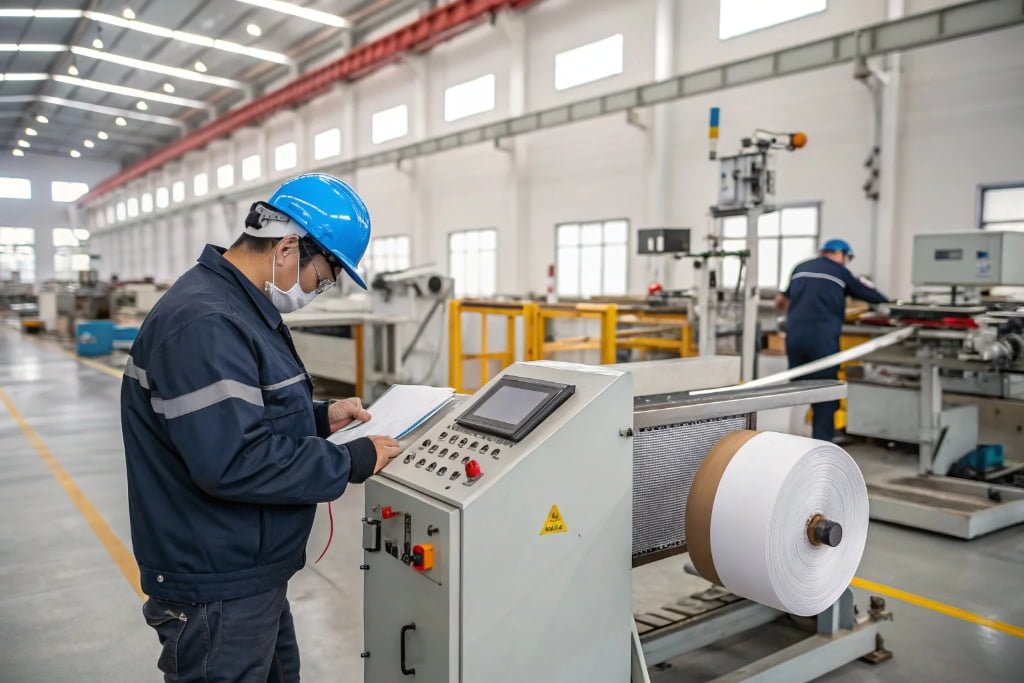
Modern automatic cutting machines work at high speed. Sharp blades, heated cutters, pneumatic systems, servo motors, and moving rollers can become dangerous if they are not used correctly.3
Safe operation helps me achieve several goals:
- Protect operators from injury
- Reduce unexpected machine downtime
- Improve cutting accuracy
- Extend blade life
- Reduce material waste
- Improve production efficiency
- Lower maintenance costs
- Meet factory safety standards
When safety becomes a habit, production becomes much smoother.
Read the Manual Before Operating the Machine
The first thing I always do is read the operating manual carefully.
Every manufacturer designs machines differently. Even two automatic webbing angle cutting machines may have different control systems, safety sensors, blade adjustment methods, or emergency stop procedures.
I never assume I already know how to operate a new machine.
The Manual Usually Explains
| Information | Why It Matters |
|---|---|
| Machine structure | Understand each component |
| Operating procedures | Avoid incorrect operation |
| Safety warnings | Prevent accidents |
| Maintenance schedule | Extend machine life |
| Error codes | Troubleshoot faster |
| Blade replacement | Prevent improper installation |
Learning these details before startup reduces operating mistakes.
Allow Only Trained Operators to Use the Machine
One of the biggest safety mistakes is allowing untrained workers to operate automatic equipment.
I always make sure only authorized personnel use the machine.
This is especially important during continuous production where operators may become tired or distracted.
Good Operator Requirements
| Requirement | Benefit |
|---|---|
| Machine training | Correct operation |
| Safety training | Lower accident risk |
| Emergency procedure knowledge | Faster response |
| Maintenance knowledge | Prevent machine damage |
Children, visitors, and unauthorized people should never stay close to the production area.4
Keep the Machine Properly Grounded
Electrical safety is just as important as mechanical safety.
Before starting production, I always check that:
- The machine is properly grounded.
- The power cable is not damaged.
- Electrical connections are secure.
- No wires are exposed.
Proper grounding protects both the operator and the electronic control system.
I also never remove safety covers or protective guards simply to make loading materials easier.
Those guards exist to prevent accidents.
Wear Proper Safety Clothing
Loose clothing can become caught in moving rollers, belts, or rotating parts.
Before operating the machine, I always wear suitable work clothing.
Recommended Safety Equipment
| Item | Purpose |
|---|---|
| Safety shoes | Foot protection |
| Safety glasses | Protect eyes |
| Close-fitting workwear | Prevent entanglement |
| Hair protection | Secure long hair |
I avoid wearing:
- Loose sleeves
- Scarves
- Necklaces
- Watches
- Rings
- Loose gloves
Keeping clothing simple greatly reduces risks around moving machinery.
What Safety Precautions Should Operators Follow During Continuous Production?
Continuous production creates different challenges than short production runs.
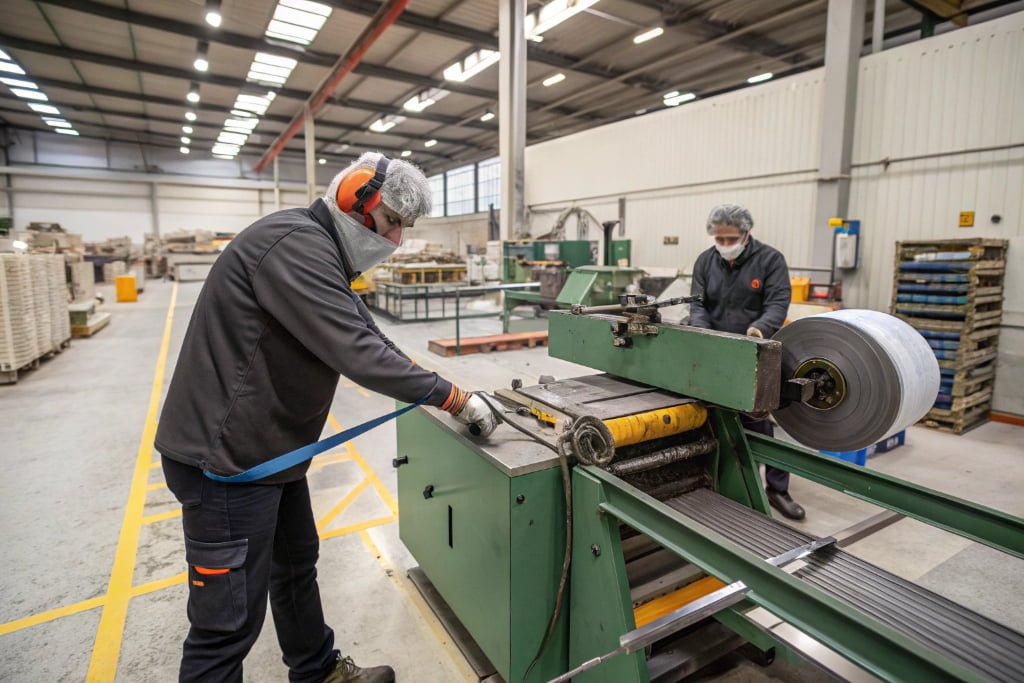
As production hours increase, fatigue, material buildup, and equipment wear become more likely. This makes daily safety habits even more important.
Keep the Work Area Clean and Organized
A clean factory floor improves both safety and productivity.
Before every production shift, I inspect the work area carefully.
I Check For
| Inspection Item | Reason |
|---|---|
| Dry floor | Prevent slipping |
| Good lighting | Improve visibility |
| Clear walkways | Safe movement |
| No scrap material | Prevent tripping |
| Organized tools | Faster maintenance |
Dust, webbing scraps, and packaging waste should be cleaned regularly during long production runs.5
Good housekeeping also makes machine inspection easier.
Inspect the Machine Before Startup
I never start production without a complete inspection.
A few minutes spent checking the machine can prevent expensive repairs later.
Daily Inspection Checklist
| Inspection | Check |
|---|---|
| Blade condition | Sharp and secure |
| Air pressure | Normal |
| Power supply | Stable |
| Emergency stop | Working |
| Safety guards | Installed |
| Servo movement | Smooth |
| Material feeding | Normal |
| Sensors | Clean |
Finding problems before startup is always cheaper than repairing damaged equipment later.
Set Cutting Parameters Carefully
Correct machine settings improve both quality and safety.
Before automatic production starts, I carefully enter:
- Cutting length
- Cutting quantity
- Cutting angle
- Feeding speed
- Temperature (for hot cutting)
- Material type
After setting the parameters, I test several pieces before full production.
Example Setup Table
| Parameter | Example |
|---|---|
| Material | Nylon webbing |
| Cutting Length | 80 mm |
| Cutting Angle | 45° |
| Quantity | 5,000 pcs |
| Feeding Speed | Medium |
| Cutting Mode | Automatic |
I also make sure the webbing stays straight throughout the feeding process.
Poor alignment can reduce cutting quality and increase blade wear.
Never Leave the Machine Running Unattended
Automatic does not mean unattended.
Even highly automated machines require regular supervision.
During production I always monitor:
- Cutting quality
- Feeding stability
- Blade condition
- Material tension
- Machine vibration
- Display alarms
- Air pressure
If I notice anything unusual, I stop the machine immediately.
Warning Signs
| Symptom | Possible Cause |
|---|---|
| Strange noise | Loose parts |
| Burning smell | Electrical problem |
| Uneven cuts | Blade wear |
| Material slipping | Feeding issue |
| Vibration | Mechanical problem |
| Error alarm | System fault |
Ignoring small problems often leads to larger repairs.6
Stop the Machine Before Maintenance
Safety never ends after production.
Whenever I need to:
- Clean the machine
- Replace blades
- Adjust components
- Remove jammed materials
- Repair parts
- Perform maintenance
I always follow the same procedure.
Safe Maintenance Procedure
- Stop machine operation.
- Turn off the main power.
- Disconnect air supply if required.
- Wait until all moving parts stop completely.
- Confirm there is no stored energy.
- Begin maintenance.
Working on a moving machine is extremely dangerous.
Waiting a few extra seconds for complete shutdown is always worthwhile.
Operate Only Within Machine Limits
Every cutting machine has its design limits.
I never attempt to cut materials beyond the manufacturer’s specifications.
Examples include:
- Materials that are too thick
- Excessively hard materials
- Explosive materials
- Flammable materials
- Hazardous chemicals
- Unknown composite materials
Using unsuitable materials may damage:
- Blades
- Servo motors
- Pneumatic cylinders
- Heating systems
- Feeding rollers
Following the machine specifications protects both the equipment and the operator.
Build Good Safety Habits Every Day
Long-term safety comes from consistent habits rather than occasional inspections.
I encourage every operator to follow the same routine every day.
Daily Safety Routine
| Time | Action |
|---|---|
| Before startup | Inspect machine |
| Before loading | Check material alignment |
| During production | Monitor cutting quality |
| During operation | Listen for abnormal sounds |
| End of shift | Clean machine |
| Weekly | Inspect blade wear |
| Monthly | Complete preventive maintenance |
Small daily habits prevent major production problems.
Common Safety Mistakes to Avoid
Many accidents happen because operators try to save time.
I avoid these common mistakes:
| Mistake | Risk |
|---|---|
| Removing safety guards | Serious injury |
| Ignoring strange sounds | Machine failure |
| Skipping inspections | Unexpected downtime |
| Wearing loose clothing | Entanglement |
| Cleaning while running | Severe injury |
| Using damaged blades | Poor quality and accidents |
| Leaving machine unattended | Material waste and equipment damage |
| Cutting unsuitable materials | Machine damage |
Avoiding these simple mistakes greatly improves workplace safety.
How Safe Operation Improves Production Efficiency
Many people think safety slows production.
I have found the opposite.
When operators follow proper procedures, production becomes much more stable.
Benefits include:
- Higher machine availability
- Better cutting accuracy
- Longer blade life
- Lower maintenance costs
- Less material waste
- Fewer emergency repairs
- More consistent product quality
- Higher customer satisfaction
Safety and productivity always work together.7
Insights from HAOXINHE
As a professional manufacturer of cutting equipment, HAOXINHE believes that machine safety is just as important as cutting precision. Every machine is designed with operator protection, stable automation, and long-term reliability in mind.
Our product range includes:
- Automatic webbing angle cutting machine
- Webbing tape cutting machine
- Hot and cold cutting machine
- High-speed trademark cutting machine
- Automatic punching cutting machine
- Round shape cutting machine
- Rotary bevel cutting machine
- Different shapes cutting machine
- Computer tube cutting machine
- Wire cutting and stripping machine
- Metal pipe cutting and beveling machine
- Bubble wrap cutting machine
- PVC Edge Banding cutting machine
- Protective Foam Cutting Machine
We recommend regular operator training, preventive maintenance, and strict safety procedures to help customers achieve continuous production with minimal downtime. Our machines are built for precision, durability, and easy operation while supporting safe working environments in packaging, textile, label, webbing, ribbon, plastic, foam, and industrial material processing.
Conclusion
Operating an automatic webbing angle cutting machine safely is not difficult when I follow clear procedures every day. Reading the manual, allowing only trained operators, wearing proper safety clothing, checking the machine before startup, setting cutting parameters correctly, monitoring production continuously, stopping the machine before maintenance, and operating only within the machine’s limits all help create a safer workplace.
These simple habits reduce accidents, improve cutting quality, extend machine life, and increase production efficiency. In the long run, safety is not an extra task. It is one of the most effective ways to protect people, improve product quality, and keep continuous production running smoothly.
-
"Safety Management – A safe workplace is sound business – OSHA", http://www.osha.gov/safety-management. Research studies have shown that regular safety inspections significantly reduce workplace accidents and improve equipment reliability, though the extent of improvement may vary by industry. Evidence role: statistic; source type: research. Supports: Safety checks reduce workplace accidents and improve machine reliability.. Scope note: Findings may not directly apply to webbing angle cutting machines specifically. ↩
-
"The Importance of Reliability and Maintainability in Manufacturing", https://rmc.utk.edu/the-importance-of-reliability-and-maintainability-in-manufacturing/. Industrial safety guidelines emphasize that proper safety practices enhance production efficiency and equipment reliability, supported by expert consensus in manufacturing operations. Evidence role: expert_consensus; source type: education. Supports: Safety practices improve production efficiency, cutting accuracy, and equipment reliability.. Scope note: General guidelines may not address specific machine types. ↩
-
"Injuries caused by sharp instruments among healthcare workers", https://pubmed.ncbi.nlm.nih.gov/23020050/. Government safety reports document cases where improper use of industrial components like sharp blades and servo motors led to workplace injuries. Evidence role: case_reference; source type: government. Supports: Industrial components like sharp blades and servo motors can cause accidents if misused.. Scope note: Specific examples may not involve webbing angle cutting machines. ↩
-
"1406 – Access to Manufacturing and Compounding for …", https://policymanual.nih.gov/1406. Government safety guidelines recommend restricting access to production areas to minimize risks, supported by industry consensus. Evidence role: expert_consensus; source type: government. Supports: Restricting access to production areas reduces safety risks.. Scope note: Guidelines may not address specific machine types. ↩
-
"Environmental Sustainability Impacts of Solid Waste … – PMC", https://pmc.ncbi.nlm.nih.gov/articles/PMC9566108/. Research indicates that maintaining cleanliness in production areas reduces accident rates and improves operational efficiency, though specific metrics may vary. Evidence role: statistic; source type: research. Supports: Regular cleaning improves safety and productivity in manufacturing environments.. Scope note: Findings may not directly apply to webbing angle cutting machines. ↩
-
"Optimal Periods of Conducting Preventive Maintenance to Reduce …", https://pmc.ncbi.nlm.nih.gov/articles/PMC8913151/. Case studies in manufacturing show that neglecting minor issues often results in costly repairs, though the severity depends on the equipment type. Evidence role: case_reference; source type: research. Supports: Ignoring minor issues can lead to major repairs in industrial equipment.. Scope note: Examples may not involve webbing angle cutting machines. ↩
-
"The Balance Between Safety and Productivity and its Relationship …", https://pmc.ncbi.nlm.nih.gov/articles/PMC6130003/. Research and expert consensus indicate that safety compliance enhances productivity by reducing downtime and improving operational efficiency. Evidence role: expert_consensus; source type: research. Supports: Safety practices improve productivity in manufacturing environments.. Scope note: Specific metrics may vary by industry and machine type.