How much does a PV EVA gasket die cutting machine cost for industrial use?
Public supplier listings show comparable industrial foam sheet cutters at USD 3,600–6,500 FOB across two examples and one automatic hydraulic EVA foam roll die cutter at USD 10,000–70,000 FOB. These examples give buyers a starting point for budgeting. They cover different configurations and come from general foam-converting equipment listings.[1][2] For a PV EVA gasket project, ask for a written quote based on your production material, finished drawing, tooling and output target. CUTOPIX publishes specifications for the HX-200DK-B2 and prices it by application. Compare the cost of the tested configuration and the total installed budget before you choose a machine.
Industrial EVA gasket die cutting machine price benchmarks
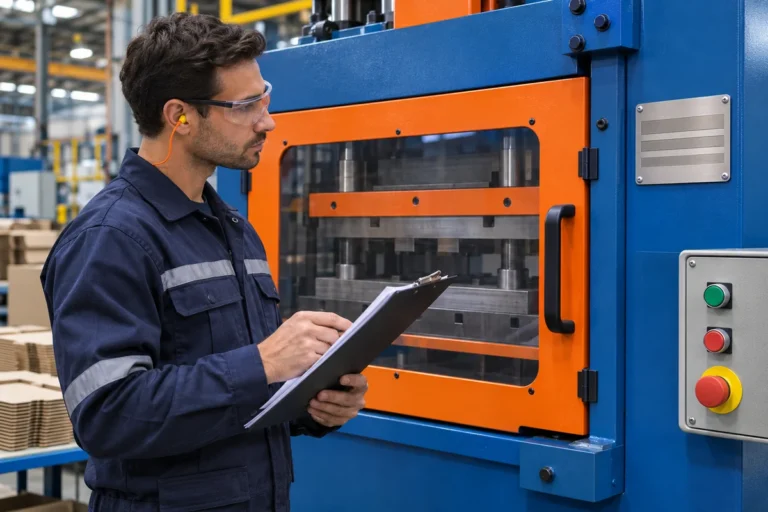
Concept illustration of a foam-converting press.
Start with the stock format. A sheet-fed press presents individual blanks to a die. When the supplier quotes roll-fed equipment, verify what handles the roll, how the stock is indexed, and what happens to the part and scrap after each cycle. Catalog terms such as “automatic” can describe the press stroke, an automatic feed step, or a wider part-handling sequence. Ask the supplier to describe every operator action from loading raw stock to collecting finished parts. That makes it easier to estimate labor and see which options belong in the quote.
| Public listing example | Advertised price in USD | What the buyer should confirm |
|---|---|---|
| Qingdao Seanoel hydraulic foam sheet cutter advertised for car-wash foam, with EVA among the listed materials | 3,600–3,800 FOB per piece | Whether the die, feed method and hold-down suit the proposed gasket.[1] |
| Manual hydraulic EVA sheet cutting press listed in the same marketplace category | 6,500 FOB per set | Platen dimensions, operator handling, tooling scope and measured output.[1] |
| Suzhou Kedou hydraulic flatbed EVA roll die cutter | 10,000–70,000 FOB per set | Which configuration is represented by the quoted price and whether unwinding, guiding, scrap removal and collection are included.[2] |
These are advertised comparisons. Listing prices can change and the configuration behind a displayed range may vary. Ask each supplier to specify the named port or delivery point and the individual items included in its offer. The sheet-fed examples describe two different listings. The roll-fed figure is one supplier’s broad range. A buyer with a narrow roll, a simple profile and modest output still needs a project-specific quote. A buyer running a wide roll with multiple cavities and automatic waste handling should ask for an itemized offer and test plan before assigning a capital budget.
Confirm which EVA material needs cutting
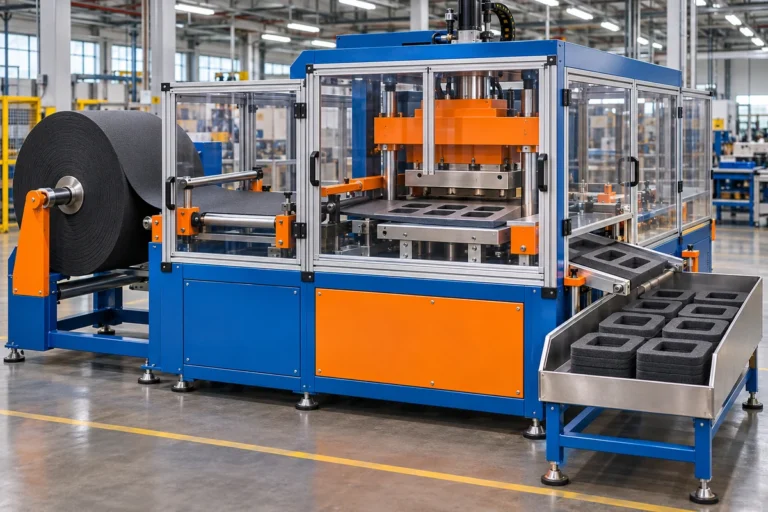
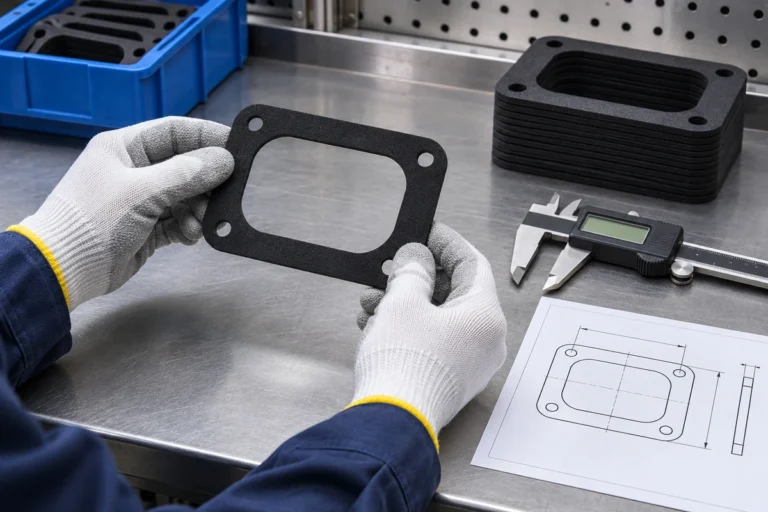
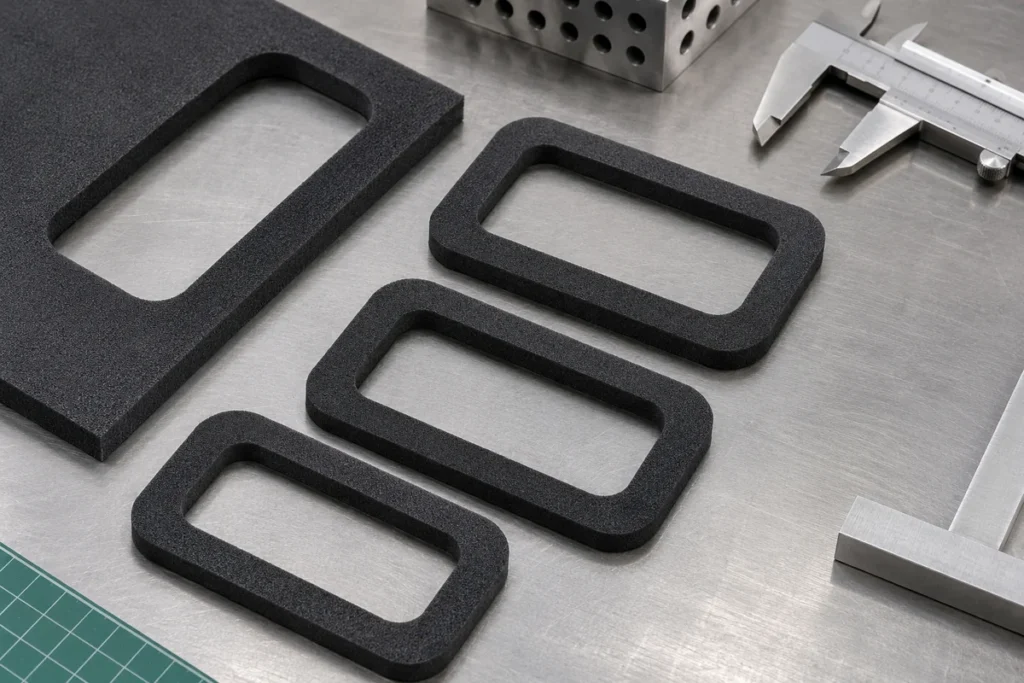
Concept illustration of finished foam frames and their surrounding offcut.
Three descriptions can appear on a PV production purchase request: die-cut foam gasket, EVA encapsulation film and module edge seal. Get the component drawing and the material specification before comparing machine prices. An industrial foam gasket order may call for a frame, spacer or cushion with a center opening or mounting holes. EVA encapsulation film is part of the laminate surrounding solar cells in common module constructions. Module edge sealants have their own material and reliability requirements. The National Renewable Energy Laboratory discusses encapsulants and edge sealants as distinct elements of photovoltaic module construction.[3] If the drawing specifies a qualified edge-seal material, follow the approved bill of materials and obtain the project’s qualification requirements before evaluating any substitute.
| Material or construction | Typical cutting requirement to confirm | Sample to send |
|---|---|---|
| Unbacked EVA foam gasket stock | Through-cut perimeter and internal openings, with loose parts collected after cutting | Production foam at the specified thickness and grade |
| Adhesive-backed EVA foam on release liner | Kiss-cut through the specified top layers with the liner intact, or through-cut if the part drawing calls for it | Production adhesive laminate including its release liner |
| EVA photovoltaic encapsulation film | Verify whether the work calls for rectangular sheeting, slitting or another film preparation step | Production film with stock width and finished blank dimensions |
| Specified module edge seal | Convert the approved sealant to the dimensions and handling requirements on the drawing | Approved material specification and representative stock |
Include roll width, core diameter, outside diameter and maximum loaded weight if you buy on rolls. For sheet stock, send the usable sheet dimensions and the direction that matters for layout or feeding. Give the supplier the total laminate thickness and the layer stack. The supplier can then check whether the selected setup can release a narrow foam frame cleanly, remove small internal pieces and retain a usable liner where required.
Which machine configuration changes the quote?
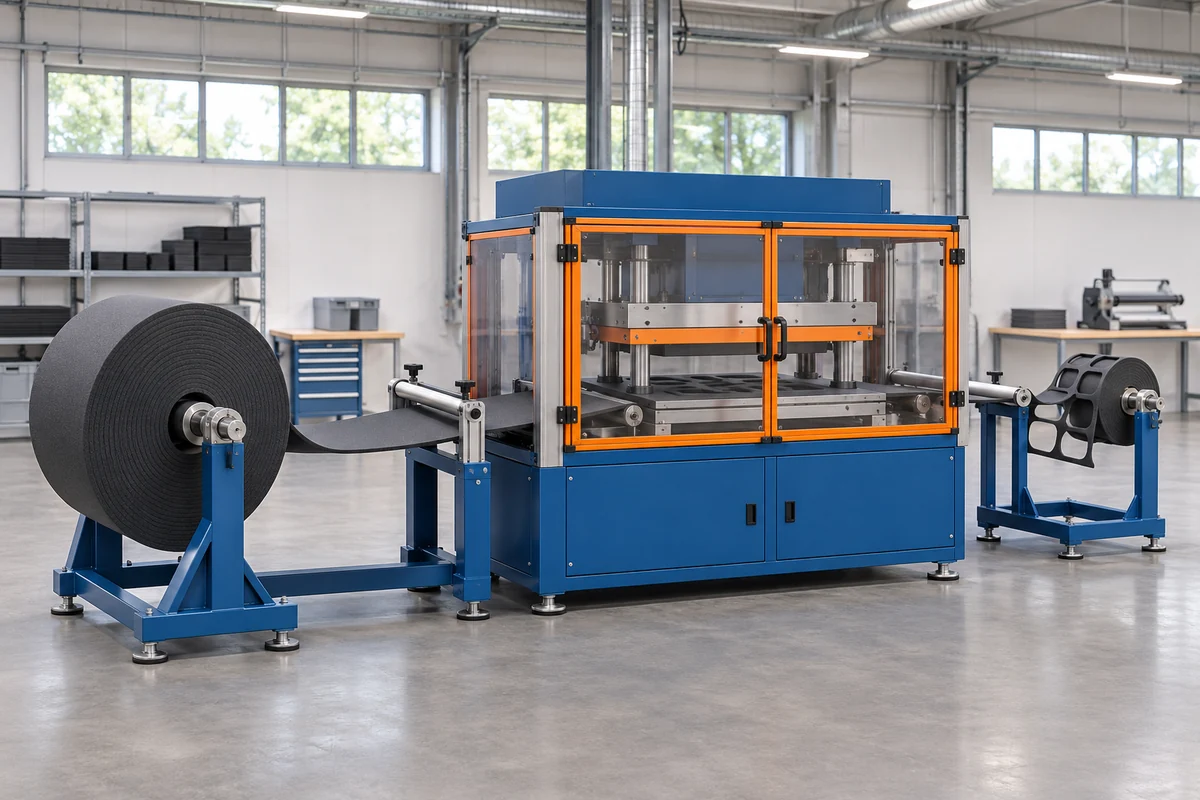
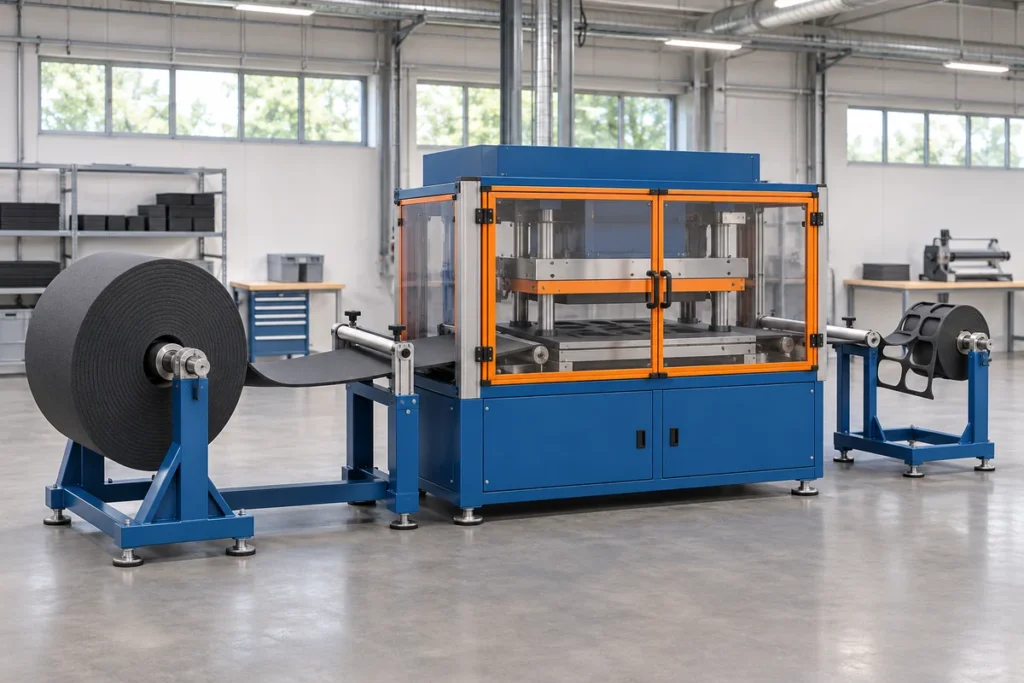
Concept layout showing roll handling, a flatbed press and trim take-up.
For low-volume sheet work, price the press, one die and the handling steps as a complete cell. Ask how the operator locates each blank and collects the cut parts. For recurring roll work, request a quote that identifies the unwind, feed, die station and exit handling separately. An application may use a simple collection tray, a liner take-up or a separate scrap rewind. The material and pick-up method determine whether each device adds value. A narrow foam frame can deform during stripping if the waste web pulls on it, so demonstrate removal with the actual material when planning an automatic setup.
The die price depends on the finished profile and the cavity layout. Ask the supplier to show the proposed nesting on the true working width, leaving any edge margins needed for stable feeding. A second cavity may improve throughput and material usage if the die fits the working area and every cavity passes inspection. A longer combined cutting perimeter may require more press force, particularly with dense or thick stock. Confirm the die footprint, maximum usable width and recommended press configuration with an actual test.
Buyers running multiple sizes should request separate tooling prices by drawing revision. Ask whether changeover requires re-centering the web, adjusting feed pitch, setting the cut depth again or replacing guides. Confirm who owns the die drawings, how replacement tooling is ordered and which wear parts the supplier can ship. Facilities with a fixed floor layout should also request an overall installation drawing showing space for roll loading, access and maintenance. For available machine families, browse the CUTOPIX punching and die cutting equipment.
Compare landed cost and cost per accepted gasket
Build two numbers for each bid. First, calculate the installed investment from the quoted equipment, tooling, applicable logistics and startup costs. Second, calculate an operating cost per accepted gasket using measured yield and labor. An offer with inexpensive base equipment can still require costly secondary handling. Likewise, a fully automated waste system makes financial sense only if it improves the process at the volume and product mix you actually run.
| Cost line | What to request in writing |
|---|---|
| Base machine | Working width, compatible stock format, controls, machine footprint and named delivery term |
| Production tooling | Die count, cavities per die, spare wear items, acceptance samples and replacement prices |
| Handling modules | Unwind or sheet feed, guides, scrap handling and finished-part collection |
| Delivery and startup | Export packing, freight, charges beyond the quoted delivery point, unloading, installation and operator training |
| Running costs | Operator time, material utilization, rejects, tooling upkeep and scheduled downtime |
| Service | Warranty scope, remote support, spare-parts lead times and any separate onsite charges |
For a costing exercise, assume a project has an illustrative installed budget of USD 24,000. Spread across 600,000 accepted parts, that is USD 0.04 per part for equipment recovery. At 300,000 accepted parts, it becomes USD 0.08 per part. These are arithmetic examples. Add material, labor, consumables, utilities and other costs to model your own production. Use the same production horizon across bids and consider what happens when volume changes or a gasket design is revised.
Calculate foam cost from the material actually consumed, including the internal window, side trim, set-up loss and rejected parts. Count any usable secondary parts from the window only if you have a qualified use for them. A more compact nest can reduce stock consumption, while extra handling to separate nested parts can offset some of that benefit. Request both the proposed layout and an observed run so the purchasing team can put a value on the trade-off.
Verify output and cut quality before accepting a quote
Write the acceptance test before approving the sale. Use your actual foam grade, adhesive and liner, preferably from the production stock. Choose the part that gives the machine the hardest cutting or handling condition, such as a frame with narrow bridges or an adhesive-backed part with a small internal opening. Ask the supplier to identify the die revision, web width and feed setting used for the test. Agree on which dimensions to measure and, for compressible foam, how the supplier should measure them without unnecessarily squeezing the part.
For through-cut frames, inspect the outside contour and internal opening after the foam has relaxed. Check for incomplete corners, hanging slugs, deformed bridges and pieces sticking to the die or waste. For kiss-cut work, test how easily a part peels from the backing and inspect the liner for penetration or tears after removal. For a multi-cavity tool, inspect parts from all cavities and ask for samples from the beginning and end of a continuous trial. If holes and contours are produced in separate operations, verify their relative position on the finished part.
Measure accepted parts per hour over an agreed trial that includes the routine handling relevant to your work. As an illustrative check, a tool running 20 strokes per minute with two cavities produces 40 gross parts per running minute. At 45 productive minutes per scheduled hour and a 95% acceptance rate, that equals 1,710 accepted parts per scheduled hour. Ask suppliers to report test conditions so you can compare figures on the same basis. Also ask which symptoms would prompt them to check feed tension, review alignment or replace a worn cutting pad.
Frequently asked questions
Can a roll-to-sheet cutter make EVA frame gaskets?
A roll-to-sheet machine is a candidate when the required part is a straight cross-cut blank. An internal opening, mounting holes or a shaped perimeter require a process capable of producing those features. For regular repeat orders, ask for a quote that includes the required punching or die-cut tooling and explain whether every operation must happen in one line. The CUTOPIX Solar PV and New Energy selection shows equipment for different material and process needs.
Can I use the same machine for through-cut and kiss-cut work?
Some equipment supports both methods with application-specific setup. The tool and the depth setting must match the exact laminate. Give the supplier both materials and specify how you want finished pieces collected. For kiss-cutting, ask for peeled samples plus the spent liner so you can inspect the release behavior and depth control.
What if my material exceeds the listed machine width?
Send the full stock width and the finished drawing. The feeder must accommodate the stock, and the tool area must accommodate the chosen cavity layout. Ask whether pre-slitting could create feedable strips and what it would do to material costs and handling. If a wider custom setup is needed, request its price, die dimensions and a trial using the widest proposed stock.
Insights: How HAOXINHE supports EVA gasket cutting projects
The CUTOPIX HX-200DK-B2 is a cold punching and cutting solution for roll materials. The product page lists a cutting width of 1–95 mm and a material thickness range of 0.01–4 mm, with other thicknesses subject to customization review. It also lists through-cut and kiss-cut as process options. Treat those values as catalog screening information. Your actual stock, adhesive layers, die geometry and required output determine what the proposed setup needs to demonstrate.
We review production materials and drawings to identify suitable feeding, tooling and collection options. Material testing can be arranged for application review. For customized machines, we can share a running video and finished samples when required under the agreed test plan. Use the test to confirm which steps are automatic, whether the finished part releases consistently and how operators collect the output.
Get a quote for your actual gasket
For an itemized proposal, send your material grade, total thickness, roll or sheet width, stock format, finished dimensions, hole pattern, tolerances and target accepted parts per hour or per shift. Attach a dimensioned drawing and photos of the material layers if available. Include your installation voltage and delivery city so the machine scope and delivery costs can be discussed together. Contact CUTOPIX for a configuration and quote or email cherryhaoxinhesz@gmail.com.
References
- Made-in-China.com — Hydraulic foam machinery listings, including Qingdao Seanoel’s sheet cutter and the manual hydraulic EVA sheet press. Source
- Made-in-China.com — Automatic flatbed die cutting machinery listings, including Suzhou Kedou’s hydraulic EVA foam roll cutter. Source
- National Renewable Energy Laboratory — F. J. John Pern, PV Module Encapsulation – Materials, Process, and Reliability. Source