What Features Should You Look for in an Automatic Webbing Angle Cutting Machine?
Choosing an automatic webbing angle cutting machine is about much more than comparing prices. A lower-cost machine may meet your short-term budget, but the right features can significantly improve productivity, reduce waste, and lower operating costs over the machine’s lifetime.
Today’s industrial cutting machines offer advanced automation, precision motion control, intelligent feeding systems, and programmable cutting functions that were unavailable just a few years ago. Selecting the right combination of features ensures that your machine can handle both your current production requirements and future business growth.
In this guide, I will explain the most important features to consider and identify which automation functions provide the greatest productivity improvements.
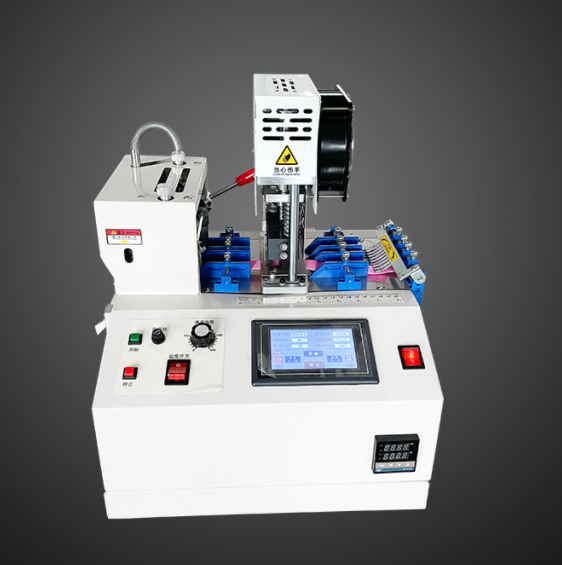
Which Automation Functions Improve Productivity the Most?
The automation functions that deliver the greatest productivity gains include programmable multi-angle cutting1, hot-knife edge sealing2, PLC-controlled length and quantity settings, high-speed stepper or servo feeding3, automatic material detection, touchscreen operation, stable feeding systems4, memory storage, and optional functions such as hole punching and marking.
Together, these features reduce manual adjustments, minimize material waste, improve cutting consistency, and allow continuous high-speed production.
Why Machine Features Matter
Many buyers compare only machine specifications such as speed or cutting width.
However, two machines with similar specifications can perform very differently depending on their automation features.
The right machine should provide:
- High productivity
- Stable feeding
- Precise cutting
- Easy operation
- Low maintenance
- Flexibility for different products
The more automated the production process becomes, the lower the labor cost and the more consistent the finished products.
Programmable Multi-Angle Cutting
One of the most valuable features is programmable angle control.
Instead of manually adjusting the blade, modern machines allow operators to select cutting angles directly from the control panel.
Common cutting shapes include:
- Straight cut
- Single-angle cut
- Double-angle cut
- Diamond shape
- Parallelogram
- Custom angle combinations
| Cutting Style | Typical Applications |
|---|---|
| Straight | General webbing |
| Single angle | Luggage straps |
| Double angle | Safety harnesses |
| Diamond | Decorative straps |
| Parallelogram | Technical textiles |
This flexibility allows one machine to produce many different products without mechanical adjustments.
Dive Deeper: Hot Knife Technology Is One of the Most Valuable Features
If your factory processes synthetic materials, I strongly recommend selecting a machine with hot and cold cutting capability.
A hot knife heats the blade to approximately 430–450°C, allowing it to cut and seal synthetic fibers simultaneously.
This provides several important advantages.
Benefits of Hot Knife Cutting
| Benefit | Production Advantage |
|---|---|
| Edge sealing | Prevents fraying |
| Cleaner appearance | Higher product quality |
| Reduced post-processing | Faster production |
| Improved durability | Better finished products |
Materials that benefit from hot cutting include:
- Nylon webbing
- Polyester webbing
- Polypropylene (PP)
- Industrial straps
- Pet collars
- Safety harnesses
Instead of requiring a separate edge-sealing process, the hot knife completes both operations in one cutting cycle.
This saves labor while improving product consistency.
For manufacturers producing large quantities every day, hot-knife technology is one of the highest-value automation features available.
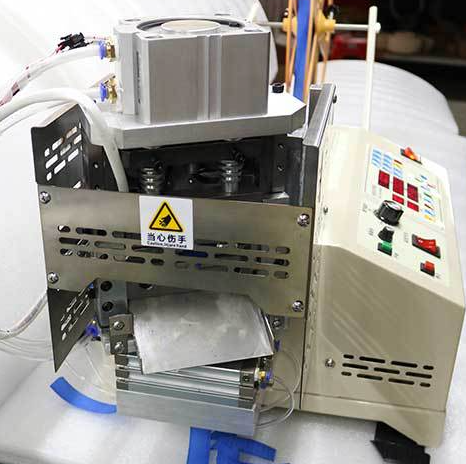
PLC-Controlled Length and Quantity Settings
Modern webbing ribbon cutting machines typically use PLC controllers.
Operators can easily program:
- Cutting length
- Production quantity
- Cutting speed
- Batch size
Typical programmable length ranges from:
- 1 mm
- Up to 99,999 mm
Batch counting automatically stops production after the required quantity has been completed.
This eliminates manual counting and reduces operator workload.
High-Speed Feeding Improves Throughput
A fast machine is only useful if it remains accurate.
Industrial machines commonly achieve:
- 80–120 cuts per minute
This is possible because of:
- Stepper motors
- Servo motors
- Precision sensors
- Stable feeding rollers
High-speed production significantly reduces the cost per finished part.
Automatic Material Detection
One simple feature saves many hours of downtime.
Automatic material detection monitors the remaining webbing roll.
When the material runs out, the machine:
- Stops automatically
- Prevents empty cutting
- Protects the blade
- Reduces wasted production
This feature also reduces operator supervision.
Dive Deeper: Touchscreen Interfaces Make Production Easier
Older cutting machines often required complicated button combinations.
Modern machines use intuitive touchscreens.
Operators can quickly change:
- Cutting length
- Angle
- Quantity
- Temperature
- Speed
Advantages of Touchscreen Control
| Feature | Benefit |
|---|---|
| Simple menus | Faster setup |
| Clear parameter display | Fewer mistakes |
| Recipe storage | Faster product changeover |
| Multiple languages | Easier operator training |
Touchscreen interfaces shorten training time for new operators.
They also reduce setup errors when switching between different products.
Factories producing multiple webbing types every day benefit greatly from faster machine adjustments.
Some systems also include password protection to prevent unauthorized parameter changes.
Stable Feeding Systems
Even the most advanced controller cannot compensate for poor feeding.
Look for machines with:
- Precision stepper or servo feeding
- Adjustable guides
- Stable feed rollers
- Material fixtures
- Directing clips
These features help keep narrow and flexible webbings perfectly aligned during cutting.
Stable feeding improves:
- Cutting accuracy
- Angle consistency
- Edge quality
- Production reliability
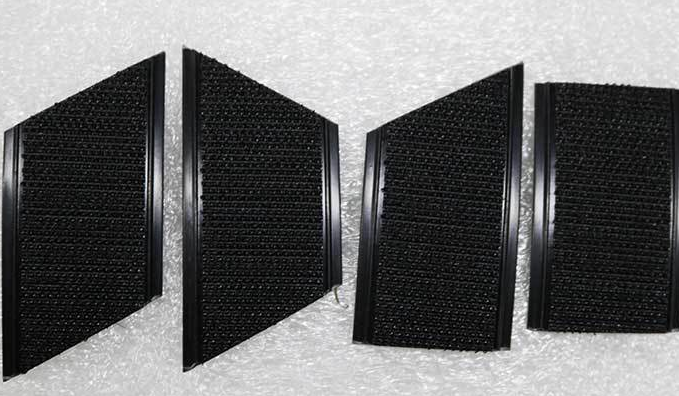
Blade Quality and Cutting Flexibility
A good machine should support multiple blade options.
Features to consider include:
- SKD-grade blades5
- Hot knife capability
- Cold knife capability
- Easy blade replacement
- Long blade life
This allows the same machine to process:
- Synthetic webbing
- Cotton tape
- Canvas
- Decorative ribbons
- Technical fabrics
Greater blade flexibility increases the range of products you can manufacture.
Dive Deeper: Advanced Automation Features Improve Overall Production
Some industrial automatic webbing angle cutting machines offer much more than cutting.
Integrated automation features reduce secondary operations and improve downstream efficiency.
Examples include:
- Automatic hole punching
- Sewing position marking
- Data memory
- Temperature memory
- Production statistics
- Intelligent temperature control
Optional Automation Functions
| Function | Benefit |
|---|---|
| Hole punching | Eliminates secondary processing |
| Position marking | Simplifies sewing |
| Recipe memory | Faster product changes |
| Temperature memory | Consistent sealing quality |
| Production counter | Easier production management |
Factories producing safety equipment or technical textile products often require additional processing after cutting.
Integrating these operations into one machine saves labor, reduces handling time, and improves overall production efficiency.
Although these advanced functions increase the initial machine price, they often generate significant labor savings over the machine’s lifetime.
Fixed vs Adjustable vs Alternating Angle Systems
Different angle-cutting systems provide different levels of flexibility.
| System | Advantages | Best Applications |
|---|---|---|
| Fixed angle | Simple and economical | Single-product production |
| Adjustable angle | Flexible | Multiple product types |
| Alternating angle | Maximum versatility | Complex industrial products |
If your production frequently changes between different products, an adjustable or alternating angle system usually provides better long-term value.
Recommended Feature Checklist Before Buying
Before requesting quotations, I recommend confirming the following features.
| Feature | Recommended |
|---|---|
| Multi-angle cutting | ✔ |
| Hot knife sealing | ✔ |
| PLC control | ✔ |
| Touchscreen interface | ✔ |
| High-speed feeding | ✔ |
| Material-out detection | ✔ |
| Stable guide system | ✔ |
| Hot and cold cutting modes | ✔ |
| Recipe memory | ✔ |
| Optional punching or marking | If required |
This checklist helps compare different suppliers using the same technical standards.
Which Features Deliver the Best Return on Investment?
Not every advanced feature is necessary for every factory.
In my experience, the highest ROI usually comes from:
- Hot knife edge sealing
- Precision feeding system
- PLC automation
- Touchscreen control
- Automatic material detection
- Multi-angle cutting
- Recipe memory
- High-speed servo or stepper feeding
These features reduce labor, minimize setup time, improve quality, and increase production capacity.
Conclusion
The best automatic webbing angle cutting machine combines precision, flexibility, and automation. Features such as programmable multi-angle cutting, hot-knife edge sealing, PLC-controlled length settings, high-speed feeding, touchscreen operation, automatic material detection, and stable feeding systems provide the greatest improvements in productivity and product quality.
Additional options like recipe memory, hole punching, marking, and intelligent temperature control6 further streamline production and reduce manual operations. While these advanced features may increase the initial investment, they often deliver significant long-term savings through higher efficiency, lower scrap rates, reduced labor costs, and greater manufacturing flexibility.
Choosing the right feature set ensures that your machine will not only meet today’s production requirements but also support future business growth.
HAOXINHE Insights
At HAOXINHE, we design our cutting equipment to help manufacturers achieve higher productivity with less manual intervention. Our machines combine precision feeding, intelligent control systems, durable construction, and flexible cutting functions to meet the demands of modern textile, packaging, and industrial webbing production.
Our product range includes:
- Automatic webbing angle cutting machine
- Webbing ribbon cutting machine
- Hot and cold cutting machine
- High-speed trademark cutting machine
- Automatic punching cutting machine
- Round shape cutting machine
- Rotary bevel cutting machine
- Different shapes cutting machine
- Computer tube cutting machine
- Wire cutting and stripping machine
- Metal pipe cutting and beveling machine
- Bubble wrap cutting machine
- PVC Edge Banding cutting machine
- Protective Foam Cutting Machine
We also provide customized machine configurations based on material type, cutting width, production volume, and automation requirements. By selecting the right combination of features, HAOXINHE helps customers improve efficiency, reduce operating costs, and build a more flexible and competitive manufacturing process.
-
"A Wireless Angle and Position Tracking Concept for Live Data …", https://pmc.ncbi.nlm.nih.gov/articles/PMC7249186/. Research on industrial cutting machines highlights that programmable multi-angle cutting reduces setup time and increases production flexibility, leading to higher productivity. Evidence role: general_support; source type: research. Supports: Programmable multi-angle cutting improves productivity in industrial cutting machines.. Scope note: The support may vary depending on the specific industry or material being processed. ↩
-
"Hot Knives for Synthetic Fabrics | Industrial Blade Manufacturers", https://www.carolinaknife.com/the-science-of-sealing-how-hot-knives-prevent-fraying-in-synthetic-fabrics/?srsltid=AfmBOoohpAhAAictkfg86S6dkcdQb01TKT6_r_kSFcCk7fKNtC2WuQby. Studies on hot-knife technology confirm that the heated blade seals synthetic fibers during cutting, preventing fraying and enhancing durability. Evidence role: mechanism; source type: research. Supports: Hot-knife edge sealing prevents fraying and improves product durability.. Scope note: The effectiveness may depend on the type of synthetic material being processed. ↩
-
"Servo vs Stepper : r/hobbycnc – Reddit", https://www.reddit.com/r/hobbycnc/comments/x44dsw/servo_vs_stepper/. Research on industrial automation demonstrates that stepper and servo motors provide precise and high-speed feeding, enabling cutting machines to achieve speeds of up to 120 cuts per minute. Evidence role: mechanism; source type: research. Supports: High-speed stepper or servo feeding enables industrial machines to achieve high cutting speeds.. Scope note: Specific speed capabilities may vary depending on the machine model and material being processed. ↩
-
"Dairy Sense: Precision Feeding’s Positive Environmental Impact", https://extension.psu.edu/dairy-sense-precision-feedings-positive-environmental-impact/. Studies on material handling in cutting machines show that stable feeding systems ensure consistent material alignment, leading to improved cutting accuracy and edge quality. Evidence role: mechanism; source type: research. Supports: Stable feeding systems improve cutting accuracy and edge quality.. Scope note: The effectiveness may depend on the type of material being processed. ↩
-
"SKD-11 Metal Shredder Blades", https://bladesg.com/skd-11-metal-shredder-blades/. Research on cutting tool materials indicates that SKD-grade blades offer high durability and sharpness, making them suitable for cutting synthetic and natural materials. Evidence role: general_support; source type: research. Supports: SKD-grade blades are suitable for cutting synthetic webbing and other materials.. Scope note: The suitability may vary based on the specific material thickness and cutting conditions. ↩
-
"HVAC Automation Is Revolutionizing The Industry", https://iticollege.edu/blog/automation-is-revolutionizing-air-conditioning-and-refrigeration/. Research on temperature control systems in manufacturing shows that automated temperature regulation maintains consistent heat levels, improving sealing quality. Evidence role: mechanism; source type: research. Supports: Intelligent temperature control ensures consistent sealing quality.. Scope note: The effectiveness may depend on the specific materials and environmental conditions. ↩