Why Does a Nylon Cutting Machine Produce Melted Edges During Cutting?
A nylon cutting machine is designed to produce clean, sealed edges when cutting synthetic materials. However, if the cutting parameters are not properly adjusted, the machine may create excessively melted, burnt, or distorted edges instead of smooth, professional cuts.
This problem is common when processing nylon webbing, ribbons, hook-and-loop tapes, and other thermoplastic materials. In most cases, the issue is not caused by the machine itself but by the combination of blade temperature, cutting speed, feed rate, blade condition, and material thickness.
In this guide, I will explain why melted edges occur and how to choose suitable temperature settings for different nylon thicknesses.
What Temperature Settings Are Suitable for Different Nylon Thicknesses?
There is no universal temperature that works for every nylon material.
Different nylon grades, webbing structures, coatings, and thicknesses all respond differently to heat. The goal is not to use the hottest blade, but to use the lowest temperature that creates a clean, fully sealed edge without burning the material.
As a general starting point, operators should perform sample cuts and fine-tune the settings.
| Nylon Thickness | Suggested Hot Knife Temperature* | Cutting Speed |
|---|---|---|
| 0.5–1.0 mm | 220–250°C | High |
| 1.0–2.0 mm | 240–280°C | Medium |
| 2.0–3.0 mm | 260–300°C | Medium-Low |
| Above 3.0 mm | 280–320°C | Low |
*Note: These values are recommended starting ranges only. The ideal temperature depends on the nylon grade, weave density, coatings, machine design, and production speed. Always verify the settings with sample cuts before full production.
Why Does Nylon Melt So Easily?
Nylon is a thermoplastic material.
Unlike natural fibers, it softens and melts when heated. Depending on the specific nylon grade, the melting point is generally around 215°C to 265°C.
This property is exactly why hot and cold cutting machines are so effective.
Instead of simply cutting the fibers, the hot knife melts the edge slightly, creating a smooth seal that prevents fraying.
However, when too much heat is applied, the edge becomes:
- Burnt
- Rounded
- Glossy
- Distorted
- Shrunken
The goal is controlled sealing—not excessive melting.
Excessive Blade Temperature Is the Most Common Cause
The first setting I check is always blade temperature.
When the hot knife is significantly hotter than necessary, heat spreads beyond the cutting line.
Instead of producing a narrow sealed edge, the machine overheats the surrounding material.
Typical Symptoms
- Thick melted edge
- Brown or yellow discoloration
- Rounded corners
- Material shrinkage
- Sticky blade surface
Solution
Lower the blade temperature gradually.
Reduce the temperature by small increments, test several pieces, and inspect the cut quality before making additional adjustments.
Temperature Troubleshooting
| Symptom | Likely Cause | Recommended Action |
|---|---|---|
| Burn marks | Temperature too high | Reduce temperature |
| Heavy melting | Excess heat | Lower blade setting |
| Poor sealing | Temperature too low | Increase temperature slightly |
| Sticky blade | Nylon buildup | Clean blade and reduce heat |
Finding the correct temperature often solves the problem immediately.
Feed Rate and Cutting Speed Must Work Together
Many operators focus only on temperature.
In reality, feed rate and cutting speed are equally important1.
If the material moves too slowly while the blade remains hot, the knife stays in contact with the nylon longer.
This extra contact time creates more friction and transfers more heat into the material.
The result is:
- Melted edges
- Glossy surfaces
- Edge deformation
On the other hand, if the feed rate is too fast, the blade may not completely cut through the material.
Good Balance
- Moderate cutting speed
- Stable feed rate
- Smooth material movement
- Consistent blade contact
These settings help produce clean sealed edges.
A Dull Blade Creates More Heat
Many people assume a dull blade simply cuts poorly.
Actually, it also generates far more heat.
A sharp blade slices through nylon quickly.
A dull blade drags across the material before finally cutting it.
That extra rubbing creates friction.
More friction means:
- Higher temperature
- Longer contact time
- Melted edges
- Material sticking to the blade
Blade Inspection Checklist
| Blade Condition | Effect on Cutting |
|---|---|
| Sharp | Clean sealed edge |
| Slightly worn | Rougher edge |
| Dull | Heavy melting |
| Damaged | Poor cutting accuracy |
Regular blade replacement is one of the simplest ways to improve cutting quality.
Is the Dwell Time Too Long?
Hot knife machines do not only use temperature.
They also control how long the blade remains in contact with the material.
This is called dwell time.
If dwell time is too long:
- Heat penetrates deeper.
- Nylon continues melting after the cut.
- The edge becomes thick and rounded.
Reducing dwell time often produces a much cleaner finish without changing the blade temperature.
Material Thickness Changes the Required Settings
Thicker nylon absorbs more heat.
It also takes longer for the blade to cut completely through the material.
Many operators solve this by greatly increasing the blade temperature.
Unfortunately, this often overheats the surface before the inner layers are fully cut.
A better approach is to balance:
- Blade temperature
- Cutting speed
- Dwell time
- Blade sharpness
Recommended Adjustments
| Material Thickness | Recommended Adjustment |
|---|---|
| Thin webbing | Lower temperature |
| Medium webbing | Standard settings |
| Thick webbing | Slightly higher temperature with slower cutting |
| Multi-layer material | Reduce speed before increasing heat |
Increasing temperature should be the last adjustment—not the first.
Poor Cooling Can Increase Edge Melting
Heat does not disappear immediately after cutting.
Nylon has relatively low thermal conductivity, so heat remains close to the cut edge2.
If heat cannot escape, the edge continues softening after the blade has moved away.
This is especially noticeable during continuous production.
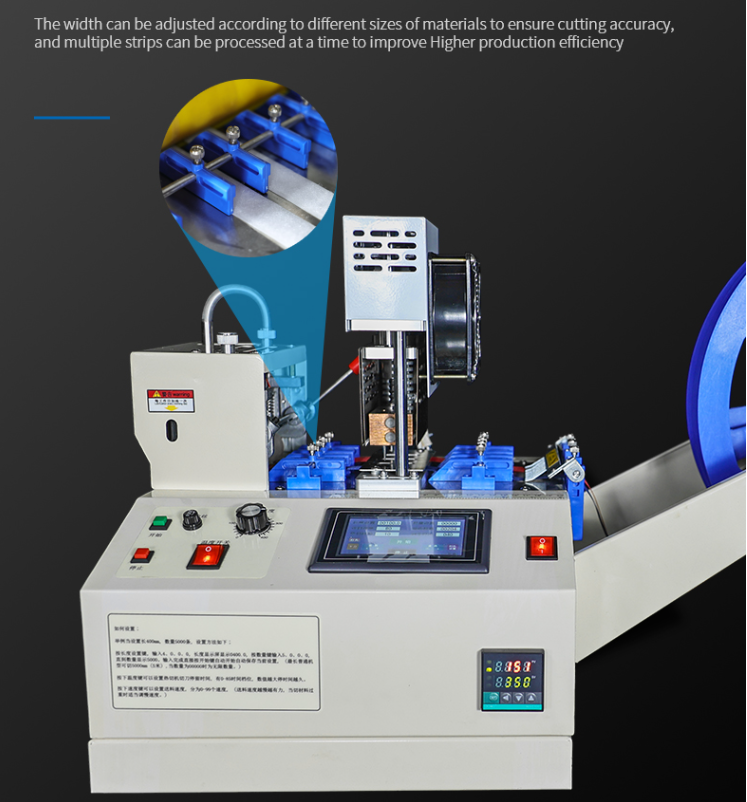
Modern industrial machines may include:
- Air cooling
- Cooling fans
- Air nozzles
- Improved ventilation
These systems help remove heat before it accumulates.
Benefits of Better Cooling
- Cleaner edges
- Less material distortion
- Reduced blade contamination
- More stable production
Multiple Continuous Cuts Can Build Up Heat
During long production runs, heat gradually builds inside both the blade and the material.
Even if the temperature setting remains unchanged, continuous cutting can increase the actual heat transferred3 into the nylon.
Common symptoms include:
- Good cuts at the beginning
- Increasing melting after several hundred pieces
- Sticky blade
- Darker edges
Possible solutions include:
- Short production pauses
- Automatic temperature control
- Blade cleaning
- Improved cooling
Stable production requires stable heat management4.
Deep Cutting Generates Excess Heat
When cutting very thick nylon in one pass, a large amount of energy enters the material.
The inner layers retain heat while the surface continues receiving additional heat from the blade.
This can produce:
- Warped edges
- Heavy melting
- Shrinkage
- Poor dimensional accuracy
For thick materials, slower cutting combined with proper blade temperature usually performs better than simply increasing heat.
Blade Design Also Matters
Not every blade is designed for plastics.
Some blades are optimized for cutting metals.
These blade geometries may generate excessive friction when cutting nylon.
A blade designed specifically for thermoplastic materials5 usually provides:
- Cleaner slicing
- Lower cutting resistance
- Less heat generation
- Better edge quality
Always use blades recommended by the machine manufacturer whenever possible.
Keep the Blade and Material Clean
Small amounts of contamination can significantly affect heat transfer6.
Common contaminants include:
- Melted nylon residue
- Textile fibers
- Dust
- Oil
- Static-attracted debris
These materials stick to the hot knife and increase friction during cutting.
Daily Cleaning Checklist
| Component | Maintenance |
|---|---|
| Hot knife | Remove melted nylon |
| Feeding rollers | Clean dust and fibers |
| Material surface | Remove dirt and oil |
| Blade holder | Check for residue |
A clean machine produces more consistent results.
How to Optimize Cutting Parameters
Whenever I process a new nylon material, I avoid making large adjustments.
Instead, I optimize one parameter at a time7.
My usual process is:
- Install a sharp blade.
- Set the recommended starting temperature.
- Run several sample cuts.
- Check the edge quality.
- Adjust temperature in small steps.
- Fine-tune feed speed.
- Optimize dwell time if necessary.
- Record the final settings for future production.
This method reduces material waste and produces repeatable results.
Parameter Optimization Table
| Parameter | If Too Low | If Too High |
|---|---|---|
| Blade Temperature | Poor sealing | Burnt edges |
| Feed Rate | Incomplete cuts | Excess heat from rubbing if too slow |
| Cutting Speed | Low productivity | Incomplete sealing if too fast |
| Dwell Time | Weak seal | Heavy melting |
| Blade Sharpness | Rough edge | Clean cutting when sharp |
Saving successful recipes allows operators to switch quickly between different nylon products.
Choosing a Machine with Better Temperature Control
When purchasing a new machine, I always pay close attention to temperature control.
High-quality webbing tape cutting machines and hot and cold cutting machines usually include:
- Digital temperature controllers
- Fast heating systems
- Stable temperature feedback
- Adjustable dwell time
- Servo-controlled feeding
- Material-specific parameter storage
These features make it much easier to process different nylon thicknesses without producing melted or burnt edges.
Whether I choose a webbing ribbon cutting machine, high-speed trademark cutting machine, automatic punching cutting machine, rotary bevel cutting machine, different shapes cutting machine, computer tube cutting machine, Bubble Wrap Cutting Machine, Protective Foam Cutting Machine, PVC Edge Banding Cutting Machine, wire cutting and stripping machine, or metal pipe cutting and beveling machine, precise process control is one of the most valuable features.
Conclusion
Melted nylon edges are usually caused by excessive heat rather than by the material itself. High blade temperatures, slow feed rates, dull blades, long dwell times, poor cooling, thick materials, and improper cutting parameters can all increase heat at the cutting zone and produce burnt or distorted edges. By using a sharp blade, optimizing temperature and feed settings, maintaining clean equipment, and testing different parameter combinations for each nylon thickness, manufacturers can consistently achieve clean, sealed, and professional cutting results.
HAOXINHE Insights
At HAOXINHE, we understand that precise temperature control is the key to high-quality nylon cutting. Our webbing tape cutting machines, hot and cold cutting machines, high-speed trademark cutting machines, automatic punching cutting machines, rotary bevel cutting machines, different shapes cutting machines, computer tube cutting machines, Bubble Wrap Cutting Machines, Protective Foam Cutting Machines, PVC Edge Banding Cutting Machines, wire cutting and stripping machines, and metal pipe cutting and beveling machines are designed with stable digital temperature control, precision servo feeding, and programmable cutting parameters.
Based on our experience with customers worldwide, most edge-melting problems can be eliminated through proper machine setup rather than excessive blade temperature. By helping customers optimize cutting recipes for different nylon grades and thicknesses, we improve product quality, reduce material waste, and support stable, high-volume production.
-
"Speeds and feeds", https://en.wikipedia.org/wiki/Speeds_and_feeds. Feed rate and cutting speed directly affect the heat distribution and contact time during nylon cutting, influencing the quality of sealed edges. Slower feed rates increase heat exposure, while faster speeds may compromise edge sealing. Evidence role: mechanism; source type: research. Supports: Describes how feed rate and cutting speed influence the heat transfer and edge quality during nylon cutting.. Scope note: Optimal settings depend on material thickness and machine design. ↩
-
"Aspects of the Fire Behavior of Thermoplastic Materials", https://nvlpubs.nist.gov/nistpubs/Legacy/TN/nbstechnicalnote1493.pdf. Nylon’s thermal conductivity is relatively low, typically around 0.25 W/m·K, which causes heat to remain localized near the cut edge during processing. Evidence role: statistic; source type: research. Supports: Provides data on nylon’s thermal conductivity and its impact on heat retention near cut edges.. Scope note: Thermal conductivity may vary slightly between nylon grades. ↩
-
"3.6. Thermal Changes in Polymers", https://books.byui.edu/plastics_materials_a/thermal_changes_in_p. During continuous cutting, heat generated by the blade can accumulate in both the material and the blade itself, increasing the risk of edge melting and distortion over time. Evidence role: mechanism; source type: research. Supports: Explains how continuous cutting operations lead to heat accumulation in nylon materials.. Scope note: Heat buildup depends on cutting speed and cooling efficiency. ↩
-
"Thermal management with innovative fibers and textiles – PMC", https://pmc.ncbi.nlm.nih.gov/articles/PMC11879428/. Stable heat management ensures consistent edge quality and prevents material distortion during high-volume nylon cutting operations. Evidence role: general_support; source type: research. Supports: Explains the importance of stable heat management in nylon cutting processes.. Scope note: Effectiveness depends on machine design and cooling systems. ↩
-
"Plastic Cutting Saw Blades | No-Melt Design for Acrylic & …", https://ridgecarbidetool.com/collections/plastic-cutting?srsltid=AfmBOopHVJ04hynk9JQlbiCRlcMTd4sjc2jSgdC1hRVPpniPjnOPa4d5. Blades optimized for thermoplastics feature geometries that reduce cutting resistance and friction, improving edge quality and reducing heat generation. Evidence role: general_support; source type: research. Supports: Explains the advantages of blades designed for thermoplastic materials.. Scope note: Performance may vary depending on material and machine compatibility. ↩
-
"Cutting Boards of Plastic and Wood Contaminated …", https://pubmed.ncbi.nlm.nih.gov/31113021/. Contamination such as melted nylon residue or dust increases friction and disrupts heat transfer during cutting, leading to inconsistent edge quality. Evidence role: mechanism; source type: research. Supports: Describes how contamination affects heat transfer and cutting performance.. Scope note: The severity of the impact depends on the type and amount of contamination. ↩
-
"Optimization of Machining Parameters for Nylon 6 …", https://www.academia.edu/86515570/Optimization_of_Machining_Parameters_for_Nylon_6_Composite_in_CNC_Lathe_Using_PCA_Based_TOPSIS. Optimizing one parameter at a time allows operators to systematically identify the best settings for cutting thermoplastics, minimizing waste and improving repeatability. Evidence role: expert_consensus; source type: education. Supports: Explains the benefits of single-parameter optimization in cutting processes.. Scope note: Effectiveness may vary depending on operator skill and machine design. ↩