Why Is My Nylon Cutting Machine Not Cutting Properly?
A nylon cutting machine should produce clean edges, accurate lengths, and smooth production. If you notice uneven cuts, incomplete cutting, burnt edges, or material slipping, the problem usually comes from a few common causes rather than a major machine failure.
Whether you operate a webbing tape cutting machine, hot and cold cutting machine, high-speed trademark cutting machine, or automatic punching cutting machine, most cutting problems can be solved through systematic troubleshooting.
In this guide, I will explain the most common reasons why a nylon cutting machine does not cut properly and show you how to quickly identify and fix each problem.
How to Troubleshoot Uneven Edges, Incomplete Cuts, and Material Slipping Problems?
Most cutting problems fall into one of five categories:
- Blade problems
- Machine setup problems
- Material feeding problems
- Temperature problems
- Mechanical or electronic problems
Instead of replacing expensive parts immediately, I always inspect these areas one by one. In many cases, the solution only takes a few minutes.
Start with the Blade
The blade is the heart of every cutting machine.
Whether your machine uses a cold knife, hot knife, or rotary blade, a dull or damaged blade is the most common cause of poor cutting quality.
A worn blade cannot cut fibers cleanly. Instead, it drags the material, causing rough edges and incomplete cuts.
Symptoms of a Worn Blade
- Frayed edges
- Burrs
- Torn fibers
- Material stretching
- Incomplete cutting
- Burn marks from excessive contact time
Solution
- Inspect the blade daily.
- Sharpen the blade if allowed by the manufacturer.
- Replace heavily worn blades.
- Clean resin or melted nylon from the blade surface.
Blade Inspection Checklist
| Problem | Possible Cause | Recommended Solution |
|---|---|---|
| Rough edge | Dull blade | Sharpen or replace |
| Material tears | Blade damage | Replace blade |
| Burrs | Worn cutting edge | Install new blade |
| Slow cutting | Dirty blade | Clean blade surface |
Regular blade maintenance often restores cutting quality immediately.
Check Blade Alignment
Even a brand-new blade performs poorly if it is installed incorrectly.
Blade alignment determines whether the knife contacts the material evenly across the full cutting width.
If the blade sits too high or too low, some areas may cut completely while others remain partially attached.
Common Signs
- Uneven edge quality
- One side cuts deeper
- Material remains connected
- Different cutting results across the width
How to Fix It
- Check blade height.
- Verify blade angle.
- Follow the manufacturer’s alignment procedure.
- Tighten blade holders securely.
Improper blade alignment can reduce accuracy even when the blade is perfectly sharp.
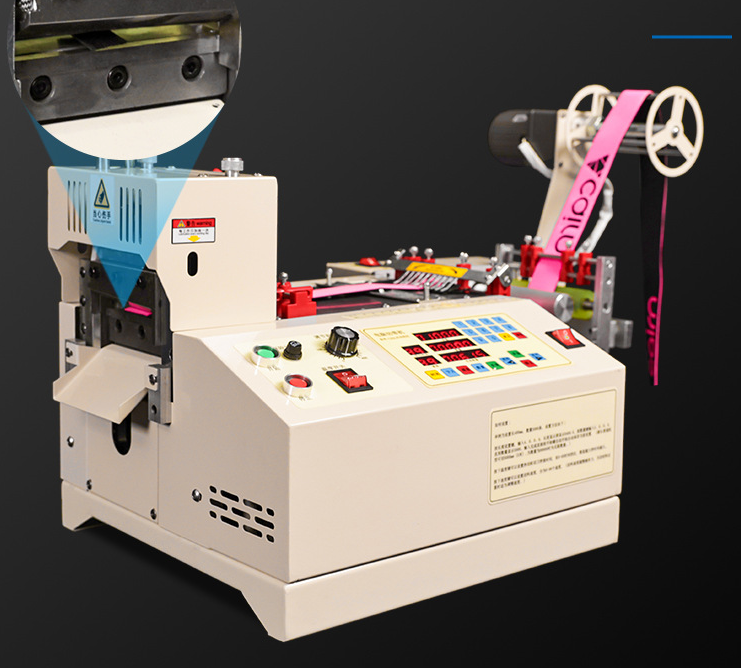
Is the Hot Knife Temperature Correct?
For hot and cold cutting machines, temperature is just as important as blade sharpness.
Nylon melts during cutting, which seals the edge and prevents fraying.1
If the temperature is incorrect, cutting quality quickly declines.
Temperature Too Low
Symptoms include:
- Frayed edges
- Loose fibers
- Poor sealing
- Material not fully separated
Temperature Too High
Symptoms include:
- Burn marks
- Yellow or brown edges
- Material shrinkage
- Melted buildup on the blade
- Smoke during cutting
Recommended Adjustment Process
- Start with the manufacturer’s recommended temperature.
- Make small adjustments.
- Test several samples.
- Inspect edge quality.
- Record the best setting for future production.
Different grades of nylon, polyester, PP webbing, and coated fabrics may require different temperatures.2
Temperature Troubleshooting
| Symptom | Temperature Condition | Solution |
|---|---|---|
| Fraying | Too low | Increase temperature |
| Burn marks | Too high | Reduce temperature |
| Sticky blade | Too hot | Lower temperature and clean blade |
| Weak seal | Too cool | Increase dwell time slightly |
Modern touch-screen controllers often allow operators to save temperature recipes for different materials.3
Is the Material Slipping During Feeding?
Material movement during cutting is another common problem.
If the webbing shifts before the blade cuts, the finished product will have inconsistent lengths and crooked edges.
Common causes include:
- Worn feeding rollers
- Weak pneumatic clamps
- Incorrect roller pressure
- Dirty rollers
- Misaligned material guides
Symptoms
- Different cutting lengths
- Angled cuts
- Crooked products
- Random production errors
Inspection Points
| Feeding Component | What to Check |
|---|---|
| Feed Rollers | Wear and contamination |
| Pneumatic Clamp | Clamping force |
| Guide Rails | Alignment |
| Material Path | Smooth feeding |
| Encoder Wheel | Slippage |
Cleaning the rollers often restores proper grip.
If the rollers become smooth after long-term use, replacement may be necessary.
Is the Feeding Speed Too High?
Many factories try to maximize production speed.
Unfortunately, excessive feeding speed can reduce cutting quality.
Nylon expands slightly when heated.4
If the material moves too quickly before cooling, it may deform.
Typical problems include:
- Wavy edges
- Inconsistent dimensions
- Material distortion
- Uneven sealing
Recommended Practice
Balance production speed with cutting quality.
Sometimes reducing speed by only 10–20% dramatically improves finished products.
Check the Cutting Surface
The cutting surface underneath the material is often overlooked.
After thousands of cutting cycles, cutting mats and support blocks wear unevenly.5
When this happens:
- Some areas cut completely.
- Other areas remain partially attached.
Signs of a Worn Support Surface
- Random incomplete cuts
- Good cuts in one location only
- Visible grooves
- Uneven pressure
Solutions
- Rotate cutting mats if possible.
- Replace worn underlays.
- Level the support surface.
- Inspect the cutting table regularly.
A flat support surface is essential for consistent cutting.
Inspect Mechanical Components
A nylon cutting machine contains many moving parts.
After years of continuous production, mechanical wear becomes unavoidable.
Common worn components include:
- Bearings
- Guide rails
- Ball screws
- Belt drives
- Linkages
- Gearboxes
- Pneumatic cylinders
Mechanical wear reduces cutting pressure and positioning accuracy.
Mechanical Symptoms
| Symptom | Possible Cause |
|---|---|
| Weak cutting force | Loose linkage |
| Position error | Worn bearing |
| Vibration | Damaged transmission |
| Noisy operation | Mechanical wear |
Preventive maintenance reduces unexpected breakdowns and extends machine life.
Verify Sensor Calibration
Automatic machines depend on electronic sensors.
Common sensors include:
- Length encoders
- Home position sensors
- Limit switches
- Servo feedback systems
- Material detection sensors
If calibration drifts over time, cutting accuracy suffers.
Typical problems include:
- Wrong cutting length
- Missed cutting positions
- Random stopping
- Feeding errors
Calibration Checklist
- Reset machine origin.
- Check encoder accuracy.
- Verify servo positioning.
- Update software if recommended.
- Recalibrate according to the manual.
Many modern high-speed trademark cutting machines include automatic calibration functions that simplify this process.
Is the Material Within Machine Specifications?
Not every material is suitable for every machine.
Attempting to cut materials outside the machine’s design limits often causes poor results.6
Examples include:
- Extra-thick nylon stacks
- Dense multilayer webbing
- Hard engineering plastics
- Heavy industrial straps beyond rated thickness
These materials may require:
- Higher cutting force
- More powerful motors
- Stronger clamps
- Specialized blades
Always compare your material specifications with the machine’s rated capacity before increasing cutting pressure or temperature.
Material Compatibility Check
| Parameter | Verify Before Cutting |
|---|---|
| Material Thickness | ✔ |
| Material Width | ✔ |
| Density | ✔ |
| Layer Count | ✔ |
| Machine Capacity | ✔ |
Using the correct machine for the application prevents overload and improves product quality.
Clean the Machine Before Troubleshooting Further
Dust, fibers, and melted nylon residue gradually build up during production.
Static electricity also attracts debris onto synthetic materials.7
Contamination may affect:
- Blade movement
- Temperature transfer
- Feeding rollers
- Sensors
- Pneumatic clamps
Oily or dirty nylon surfaces can also reduce friction between the material and the feeding rollers, leading to slipping.
Daily Cleaning Checklist
- Clean blade surfaces.
- Remove melted nylon residue.
- Wipe feeding rollers.
- Vacuum textile dust.
- Clean sensors.
- Remove debris from guide rails.
A clean machine is often a more accurate machine.
Preventive Maintenance Reduces Future Problems
Most cutting problems can be avoided through regular maintenance.
I recommend creating a preventive maintenance schedule.
Daily
- Clean machine
- Inspect blade
- Check emergency stop
- Remove debris
Weekly
- Inspect rollers
- Check blade alignment
- Lubricate moving parts
- Verify temperature accuracy
Monthly
- Inspect bearings
- Check pneumatic system
- Calibrate sensors
- Inspect electrical connections
Maintenance Schedule
| Frequency | Maintenance Task |
|---|---|
| Daily | Cleaning and blade inspection |
| Weekly | Alignment and lubrication |
| Monthly | Calibration and mechanical inspection |
| Quarterly | Comprehensive preventive maintenance |
Regular maintenance not only improves cutting quality but also reduces unexpected downtime.
When Should You Contact the Manufacturer?
Some problems require technical support rather than routine maintenance.
Contact your machine supplier if you notice:
- Servo motor alarms
- Controller error codes
- Repeated sensor failures
- Electrical faults
- Severe vibration
- Continuous overheating
- Pneumatic system failure
- Software communication errors
Attempting to repair complex electrical or servo systems without proper training may create additional damage.
Reliable suppliers usually provide remote diagnostics, troubleshooting guides, and spare parts support to minimize production interruptions.
Choosing a Machine That Is Easier to Troubleshoot
When purchasing a new machine, I always consider long-term maintenance as much as cutting performance.
Machines with the following features are much easier to diagnose and repair:
- Touch-screen fault display
- Automatic alarm system
- Servo-controlled feeding
- Adjustable hot knife temperature
- Modular blade assembly
- Easy-access maintenance panels
- Automatic parameter storage
- Replaceable wear components
These features reduce downtime and make daily maintenance much simpler for operators.
Whether I choose a webbing tape cutting machine, hot and cold cutting machine, high-speed trademark cutting machine, automatic punching cutting machine, rotary bevel cutting machine, different shapes cutting machine, computer tube cutting machine, Bubble Wrap Cutting Machine, Protective Foam Cutting Machine, PVC Edge Banding Cutting Machine, wire cutting and stripping machine, or metal pipe cutting and beveling machine, easy troubleshooting is always an important consideration.
Conclusion
Most nylon cutting machine problems are caused by routine issues such as dull blades, incorrect blade alignment, improper hot-knife temperature, unstable feeding, worn cutting surfaces, mechanical wear, or sensor calibration errors. By following a logical troubleshooting process and performing regular preventive maintenance, manufacturers can restore cutting quality quickly, reduce downtime, and extend machine life. Small adjustments often solve problems before they become expensive repairs.
HAOXINHE Insights
At HAOXINHE, we design our cutting equipment to simplify both production and maintenance. Our webbing tape cutting machines, hot and cold cutting machines, high-speed trademark cutting machines, automatic punching cutting machines, rotary bevel cutting machines, different shapes cutting machines, computer tube cutting machines, Bubble Wrap Cutting Machines, Protective Foam Cutting Machines, PVC Edge Banding Cutting Machines, wire cutting and stripping machines, and metal pipe cutting and beveling machines feature user-friendly touch-screen controls, adjustable cutting parameters, precision servo feeding, and modular blade systems.
Based on our experience serving manufacturers around the world, most production issues can be resolved through proper machine setup, routine inspection, and regular preventive maintenance. By combining reliable equipment with responsive technical support and readily available spare parts, we help customers minimize downtime and maintain consistent cutting quality across a wide range of materials.
-
"How to Melt Nylon Webbing Together?", https://cutopix.com/how-to-melt-nylon-webbing-together/. Melting nylon during cutting creates a sealed edge by fusing fibers, which prevents fraying. This process is effective for synthetic materials with thermoplastic properties. However, edge sealing quality may vary depending on the nylon grade and cutting temperature. Evidence role: mechanism; source type: research. Supports: Explains how melting nylon during cutting seals edges and prevents fraying.. Scope note: Effectiveness may depend on material composition and machine settings. ↩
-
"Review of Cutting Temperature Measurement Methods – PMC", https://pmc.ncbi.nlm.nih.gov/articles/PMC10573455/. Different grades of synthetic materials like nylon, polyester, and PP webbing require specific cutting temperatures to achieve optimal edge quality. Temperature settings should be adjusted based on material properties. Evidence role: general_support; source type: research. Supports: Confirms that different synthetic materials require specific cutting temperatures.. Scope note: Exact temperature ranges depend on material composition. ↩
-
"Energy Tips for Commercial Buildings | doee – DC.gov", https://doee.dc.gov/service/energy-tips-commercial-buildings. Many modern cutting machines feature touch-screen controllers that allow operators to save temperature settings for specific materials, improving efficiency and consistency. This capability is common in machines designed for synthetic textiles. Evidence role: general_support; source type: institution. Supports: Confirms that modern cutting machines with touch-screen controllers can save temperature settings for different materials.. Scope note: Not all machines or manufacturers may include this feature. ↩
-
"Nylon", https://en.wikipedia.org/wiki/Nylon. Nylon exhibits slight thermal expansion when heated due to its thermoplastic nature. This property can affect cutting accuracy if the material moves before cooling. Expansion rates depend on the specific nylon grade and temperature applied. Evidence role: mechanism; source type: paper. Supports: Explains the thermal expansion properties of nylon when heated.. Scope note: Expansion rates vary by nylon type and environmental conditions. ↩
-
"Accuracy of Patient Specific Cutting Blocks in Total Knee …", https://pmc.ncbi.nlm.nih.gov/articles/PMC4164815/. Cutting mats and support blocks can wear unevenly after extensive use, leading to inconsistent cutting results. Regular inspection and replacement of worn surfaces are recommended to maintain accuracy. Evidence role: general_support; source type: research. Supports: Describes how wear on cutting mats and support blocks affects cutting accuracy.. Scope note: Specific wear patterns depend on machine type and usage frequency. ↩
-
"Cyber–Physical Systems for High-Performance Machining of …", https://pmc.ncbi.nlm.nih.gov/articles/PMC11014020/. Cutting materials beyond a machine’s design limits can lead to poor results, including incomplete cuts and equipment strain. Manufacturers recommend adhering to specified material thickness and density limits. Evidence role: general_support; source type: education. Supports: Explains how cutting materials outside machine design limits affects quality.. Scope note: Specific issues depend on machine type and material properties. ↩
-
"Static electricity", https://en.wikipedia.org/wiki/Static_electricity. Static electricity can attract debris to synthetic materials like nylon due to the accumulation of electrical charges on the material’s surface. This phenomenon is common in environments with high friction or dry air conditions. Evidence role: mechanism; source type: research. Supports: Explains how static electricity attracts debris to synthetic materials.. Scope note: Debris attraction may vary based on environmental factors. ↩