What Is the Ideal Cutting Speed for Different Roll-to-Sheet Applications?
Manufacturers often ask a simple question when choosing a roll-to-sheet cutting machine: what is the ideal cutting speed?
The answer is not as simple as a single number. Many buyers focus on maximum machine speed when comparing equipment. However, the fastest machine is not always the most productive machine. In real production environments, the ideal cutting speed depends on several factors, including material type, sheet length, thickness, tension control, downstream processing, and quality requirements.
I have worked with manufacturers that process paper, plastic film, labels, foam, nonwoven materials, protective packaging, and various industrial substrates. In nearly every case, the best results came from finding a balance between speed, accuracy, and stability rather than simply running the machine at its maximum capacity.
Modern automatic roll-to-sheet cutting machines can achieve impressive production rates while maintaining excellent cutting precision. However, different materials respond differently to blade movement, feeding speed, and web tension. A speed that works perfectly for thin film may create defects when processing thick cardboard or foam materials.
In this article, I will explain how production requirements should influence machine speed selection and how manufacturers can determine the most efficient cutting speed for their specific applications.
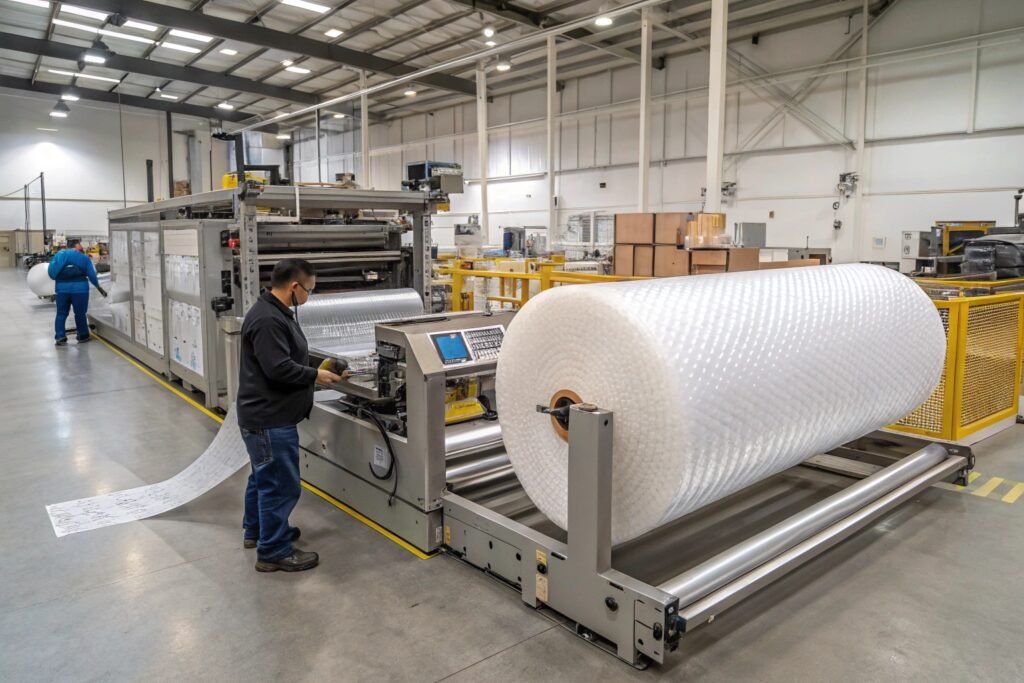
How Should Production Requirements Influence Machine Speed Selection?
Production requirements should always determine machine speed settings. The ideal cutting speed is the fastest speed that maintains consistent accuracy, stable material flow, clean edges, and reliable downstream processing.
Many operators assume that increasing speed automatically increases productivity. In reality, excessive speed can cause misfeeds, wrinkles, inaccurate lengths, material damage, and production downtime.
The goal is not maximum speed.
The goal is maximum usable output.
Factors That Influence Ideal Cutting Speed
| Production Factor | Impact on Speed Selection |
|---|---|
| Material Type | Determines stability and tension requirements |
| Material Thickness | Thicker materials often require slower speeds |
| Sheet Length | Shorter sheets require more cutting cycles |
| Accuracy Requirements | Higher precision may require controlled speeds |
| Downstream Equipment | Speed must match handling systems |
| Product Quality Standards | Surface quality limits maximum speed |
The most successful manufacturers optimize cutting speed based on the complete production process rather than focusing on machine specifications alone.
Material Type Matters More Than Maximum Machine Speed
Material behavior is often the biggest factor affecting cutting speed.
Different substrates react differently when moving through a roll-to-sheet cutting system. Flexible materials, rigid materials, thick materials, and delicate materials all require different operating conditions.
Common Material Categories
| Material Type | Typical Speed Potential |
|---|---|
| Thin Plastic Film | High |
| Paper Rolls | Medium to High |
| Labels and Liners | Medium |
| Foam Materials | Medium |
| Nonwoven Fabrics | Medium to High |
| Thick Cardboard | Medium to Low |
| Composite Materials | Low to Medium |
Flexible materials usually allow higher speeds because they move smoothly through feeding systems when web tension is properly controlled.
Materials such as PE film, PET film, bubble wrap, and nonwoven fabrics can often run at faster production rates because they generate less resistance during feeding.
However, thicker or stiffer materials require more controlled movement.
For example, paperboard, laminated materials, and protective foam products often need reduced speeds to maintain cutting quality and dimensional accuracy.
I often tell buyers that material behavior matters more than machine specifications. A machine rated for very high speed may still need slower settings when processing difficult substrates.
Sheet Length Directly Affects Production Speed
Sheet size has a major impact on achievable cutting speed.
Many people overlook this factor when comparing machine performance.
Short sheets require more cutting cycles within the same production period. Each cutting action requires machine movement, blade operation, and material positioning.
Speed Comparison by Sheet Length
| Sheet Length | Cutting Frequency | Productivity Impact |
|---|---|---|
| 100 mm | Very High | Lower overall throughput |
| 300 mm | High | Moderate throughput |
| 500 mm | Medium | Higher throughput |
| 1000 mm | Lower | Maximum material output |
Smaller cuts usually require more machine cycles.
For example, a machine producing 100 mm sheets must perform significantly more cuts than the same machine producing 1000 mm sheets from identical material rolls.
This is why manufacturers should evaluate production capacity based on actual application requirements rather than headline speed figures.
A machine may appear slower when producing short sheets, yet still operate at optimal efficiency.
Why Short Sheets Take Longer
More Cutting Cycles
Every cut requires machine action.
Increased Material Positioning
The machine must repeatedly measure and position the material.
Greater Control Requirements
Short lengths leave less room for positioning errors.
As sheet length decreases, cutting precision becomes even more important.
Material Thickness Often Requires Slower Cutting Speeds
Thickness plays a critical role in machine performance.
Thicker materials generate more resistance during feeding and cutting. They may also create greater stress on blades and feeding systems.
Thickness Impact on Speed
| Material Thickness | Recommended Speed Trend |
|---|---|
| Very Thin Film | Faster |
| Standard Paper | Moderate to Fast |
| Heavy Paperboard | Moderate |
| Foam Products | Moderate |
| Thick Laminates | Slower |
When processing thick materials, slower speeds often produce better results.
The reason is simple.
The blade requires additional time to create a clean cut without tearing, crushing, or deforming the material.
For example, manufacturers using Protective Foam Cutting Machines or Bubble Wrap Cutting Machines frequently discover that moderate speeds provide better edge quality than maximum speed settings.
The same principle applies to PVC edge banding, industrial webbing, and composite materials.
Higher speed only creates value if product quality remains consistent.
Cutting Accuracy Must Remain Stable at Production Speed
Speed means little if accuracy suffers.
Most manufacturers care about dimensional consistency because inaccurate sheets create problems during printing, packaging, converting, and assembly operations.
Modern high-end roll-to-sheet cutting machines can typically maintain cutting accuracy within approximately ±0.1 mm to ±0.3 mm under normal production conditions.
Accuracy vs Speed Balance
| Priority | Result |
|---|---|
| Maximum Speed Only | Risk of defects |
| Maximum Accuracy Only | Reduced productivity |
| Balanced Optimization | Best overall efficiency |
The best machine settings maintain precision while maximizing throughput.
Signs Speed Is Too High
Length Variations
Finished sheets become inconsistent.
Material Slippage
The web moves unexpectedly during feeding.
Edge Defects
Cut quality begins to decline.
Registration Problems
Printed graphics become misaligned.
Whenever these issues appear, reducing speed often restores production stability.
Manufacturers should always validate quality before increasing output rates.

Flexible Materials Can Often Run Faster with Proper Tension Control
Tension control is one of the most important features in modern roll-to-sheet cutting systems.
Flexible materials naturally stretch, contract, and react to changes in feeding force.
Without proper tension management, even high-quality machines can experience production problems.
Materials That Benefit from Tension Control
- PET Film
- PE Film
- Label Stock
- Nonwoven Fabric
- Thin Packaging Materials
- Webbing Materials
When tension remains stable, flexible materials can usually run at higher speeds without sacrificing accuracy.
Benefits of Proper Tension Control
| Benefit | Production Impact |
|---|---|
| Stable Material Flow | Higher Speeds |
| Reduced Wrinkles | Better Quality |
| Consistent Length Control | Higher Accuracy |
| Lower Scrap Rates | Better Efficiency |
For applications involving Webbing Ribbon Cutting Machines and High-Speed Trademark Cutting Machines, precise tension control is often the key factor that enables faster production.
Without proper tension management, speed increases quickly lead to quality issues.
Downstream Equipment Must Match Cutting Speed
A cutting machine does not operate in isolation.
The entire production line must work together.
Automatic systems achieve their highest efficiency when cutting speed is synchronized with downstream processes such as stacking, counting, inspection, packaging, or rewinding.
Production Line Synchronization
| Equipment Stage | Must Match Cutting Speed? |
|---|---|
| Feeding System | Yes |
| Cutting Unit | Yes |
| Counting System | Yes |
| Stacking Unit | Yes |
| Packaging Line | Yes |
Many manufacturers focus only on cutting performance while ignoring downstream bottlenecks.
If the cutting machine produces sheets faster than the stacking system can handle them, production efficiency decreases.
Material jams, handling delays, and downtime become more common.
The best cutting speed is often determined by the slowest stable process within the production line.
Faster Is Not Better If Defects Increase
Many buyers assume that higher machine speed always means higher profitability.
This assumption can be costly.
Defective products create hidden expenses that quickly erase any gains from faster production.
Common Problems Caused by Excessive Speed
| Problem | Business Impact |
|---|---|
| Misfeeds | Production Interruptions |
| Wrinkles | Product Rejection |
| Edge Defects | Customer Complaints |
| Material Waste | Higher Costs |
| Rework | Additional Labor |
A production line running at 80% of maximum speed with excellent quality often outperforms a line operating at 100% speed with frequent defects.
Manufacturers should evaluate total good output rather than machine speed alone.
This approach usually delivers better profitability and customer satisfaction.
Different Applications Require Different Speed Priorities
Every roll-to-sheet application has unique production goals.
Speed Priorities by Industry
| Industry | Primary Priority |
|---|---|
| Printing Industry | Accuracy |
| Packaging Industry | Balanced Speed and Quality |
| Label Manufacturing | Precision |
| Foam Processing | Edge Quality |
| Plastic Film Processing | High Throughput |
| Webbing Production | Consistency |
For example:
Paper Processing
Paper converters often prioritize accuracy and stack quality.
Plastic Film Production
Film processors may prioritize throughput while maintaining tension control.
Foam Cutting
Foam manufacturers typically prioritize clean edges and dimensional stability.
Label Converting
Label producers usually require extremely precise cut lengths.
Because each application has different priorities, there is no universal ideal cutting speed.
How to Determine the Best Speed for Your Production Line
The most reliable approach is systematic testing.
Recommended Evaluation Process
Step 1: Start at Moderate Speed
Establish stable production conditions.
Step 2: Measure Accuracy
Verify length consistency and edge quality.
Step 3: Increase Speed Gradually
Monitor defects and machine performance.
Step 4: Evaluate Downstream Equipment
Ensure handling systems keep pace.
Step 5: Identify Maximum Stable Speed
Select the highest speed that maintains quality.
This method helps manufacturers find the true optimal operating point.
The best speed is not necessarily the highest speed available on the machine.
The best speed is the highest speed that consistently produces saleable products.
Conclusion
There is no single ideal cutting speed for every roll-to-sheet application. The optimal speed depends on material type, thickness, sheet length, accuracy requirements, tension control, and downstream production capabilities.
Flexible materials often support higher speeds when tension is properly managed, while thicker and stiffer materials generally require slower operation to maintain cut quality. Smaller sheet sizes also reduce achievable throughput because they require more cutting cycles.
The most successful manufacturers focus on overall production efficiency rather than maximum machine speed. They choose the fastest speed that maintains accuracy, clean edges, stable material flow, and reliable downstream handling.
In roll-to-sheet production, the best cutting speed is always the speed that delivers the highest amount of defect-free output.
Insights: Why HAOXINHE Machines Help Customers Optimize Cutting Speed
HAOXINHE designs cutting equipment that balances speed, precision, and long-term reliability across a wide range of materials.
Our product portfolio includes:
- Webbing Tape Cutting Machine
- Hot and Cold Cutting Machine
- High-Speed Trademark Cutting Machine
- Automatic Punching Cutting Machine
- Round Shape Cutting Machine
- Rotary Bevel Cutting Machine
- Different Shapes Cutting Machine
- Computer Tube Cutting Machine
- Wire Cutting and Stripping Machine
- Metal Pipe Cutting and Beveling Machine
- Webbing Ribbon Cutting Machine
- Bubble Wrap Cutting Machine
- PVC Edge Banding Cutting Machine
- Protective Foam Cutting Machine
Advantages of HAOXINHE Equipment
| HAOXINHE Feature | Customer Benefit |
|---|---|
| Servo-Controlled Feeding | Higher Accuracy at Production Speed |
| Programmable Length Control | Fast Product Changeovers |
| Stable Tension Systems | Better Performance on Flexible Materials |
| Precision Cutting Technology | Cleaner Edges |
| High-Speed Operation | Increased Productivity |
| Automatic Counting Functions | Improved Workflow Efficiency |
| Durable Machine Structure | Reliable Long-Term Performance |
With five production lines and years of export experience serving Europe, Singapore, and North America, HAOXINHE helps manufacturers select cutting equipment that delivers the right balance of speed, quality, and profitability for every application.